Lamborghini
Ferruccio Lamborghini founded Automobili Lamborghini in 1963 in Sant'Agata Bolognese, Italy. Already a successful tractor manufacturer, he set out to build high-performance grand tourers that could challenge Ferrari. The brand quickly established its identity with the 1966 Miura, which pioneered the mid-engine layout for production supercars, followed by the wedge-shaped Countach and its signature scissor doors.
A subsidiary of the Volkswagen Group under Audi since 1998, Lamborghini produces its supercars and SUVs at its expanded Sant'Agata Bolognese facility. The brand's historical lineup includes iconic models like the Diablo, Murciélago, Gallardo, Aventador, and Huracán.
Under its Direzione Cor Tauri strategy, Lamborghini is hybridizing its entire vehicle range. Modern production centers on the flagship Revuelto V12 plug-in hybrid, the twin-turbo V8 Temerario, and the Urus SE performance SUV.
Models over time
Lamborghini 350 GT
Lamborghini Miura
Lamborghini Countach
Lamborghini LM002
Lamborghini Diablo
Lamborghini Murciélago
Lamborghini Gallardo
Lamborghini Reventón
Lamborghini Aventador
Lamborghini Sesto Elemento
Lamborghini Veneno
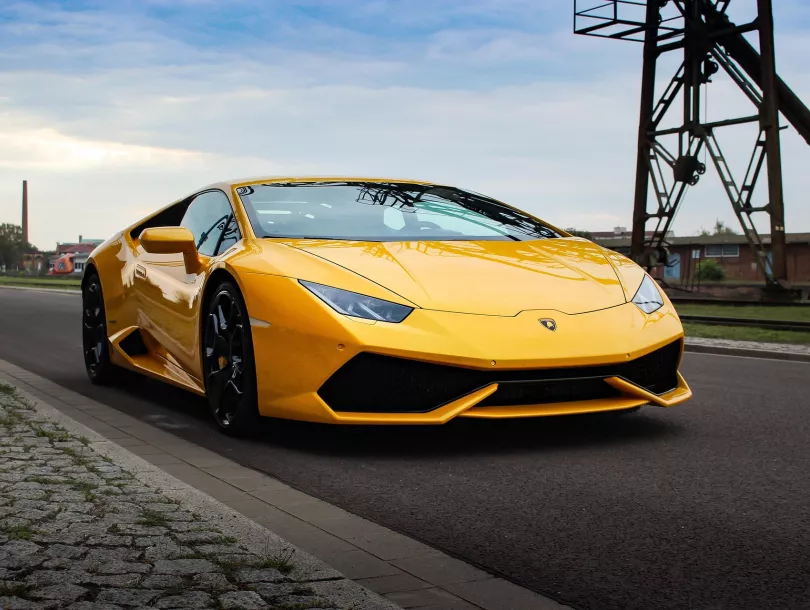
Lamborghini Huracán
Lamborghini Centenario
Lamborghini Urus
Lamborghini Essenza SCV12
Lamborghini Sián FKP 37
Lamborghini Countach LPI 800-4
Lamborghini Revuelto
Lamborghini Fenomeno
Lamborghini Temerario
Selected cars
Lamborghini Urus
Lamborghini Huracán
Lamborghini LM002
Lamborghini Miura
Related articles
Data
Registration
Official recall campaigns.
Facts
The Revuelto uses two electric motors at the front axle and a third integrated into the rear powertrain.
Combined output from the V12 and three electric motors is 1,015 CV.
The chassis combined a steel structure with CFRP reinforcement elements.
The Reventón introduced extensive use of carbon-fibre-reinforced composite body panels in a Lamborghini limited series.
The Reventón Roadster used a naturally aspirated 6.5-litre V12 producing 650 CV.
The final Murciélago LP 670-4 SuperVeloce produced 670 CV.
The LP 640-4 update increased V12 output to 640 CV.
The original Murciélago used a 6.2-litre V12 producing 580 CV at 7,200 rpm.
Early Miuras housed the engine, gearbox and differential together and used a shared lubrication system.
The Miura mounted its V12 transversely behind the passenger compartment, creating an unusually compact powertrain layout.
More facts about Lamborghini
Showing 21–30 of 200 facts