Aston Martin
Aston Martin was founded in 1913 in London by Lionel Martin and Robert Bamford. The British manufacturer operates its primary headquarters and sports car production facility in Gaydon, Warwickshire, while assembling its SUV line in St Athan, Wales. The company's identity was largely shaped during the tenure of industrialist Sir David Brown - whose initials still designate the "DB" model series - and was cemented globally after the DB5 featured in the 1964 James Bond film Goldfinger.
Models over time
Aston Martin DB4 GT
Aston Martin DB5
Aston Martin Vanquish
Aston Martin Vantage
Aston Martin One-77
Aston Martin Vulcan
Aston Martin DBS Superleggera
Aston Martin DBX
Aston Martin Valkyrie
Aston Martin DBX707
Aston Martin DB12
Aston Martin Valour
Aston Martin Valiant
Aston Martin Valhalla
Selected cars
Aston Martin Valhalla
Aston Martin DBX707
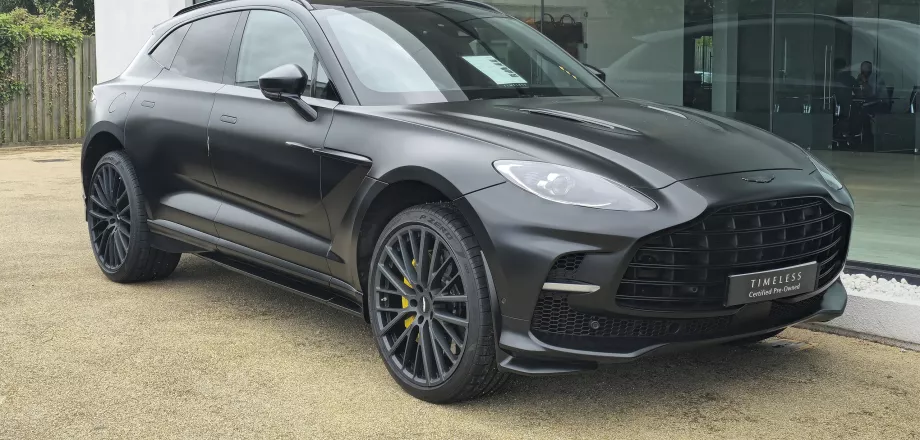
Aston Martin Valkyrie
Related articles
Data
Registration
Official recall campaigns.
Facts
The two front electric motors enable active torque distribution between the left and right front wheels.
The hybrid system uses three electric motors, including two independent motors driving the front wheels.
The Valhalla’s combustion engine alone produces 828 PS, equal to roughly 207 PS per litre.
The Valhalla’s 4.0-litre V8 is Aston Martin’s first series-production engine to use a flat-plane crankshaft.
The Valhalla hybrid powertrain produces a combined 1,079 PS and 1,100 Nm.
The One-77 used a naturally aspirated 7.3-litre V12, then the largest road-car engine offered by Aston Martin.
The One-77 is built around a carbon-fibre monocoque designed as a light and very rigid structural core.
The DBX707 uses a shorter 3.27 final-drive ratio instead of the standard DBX’s 3.07 ratio, sharpening powertrain response.
Aston Martin says the carbon-ceramic brakes reduce unsprung mass by 40.5 kg.
The DBX707’s standard braking system uses 420 mm front and 390 mm rear carbon-ceramic discs.
More facts about Aston Martin
Showing 31–40 of 140 facts