The De Tomaso Pantera arrived when a mid-engined road car was still something exotic. Anyone looking for Ferrari or Lamborghini performance generally had to accept a substantial purchase price and the demands of specialist, low-volume engineering. De Tomaso offered a different combination: a body styled at Ghia, chassis development associated with Giampaolo Dallara, and a muscular V8 drawn from Ford's production engine range. With an American industrial partner behind it, the Pantera was intended to reach far more customers than the company's earlier sports cars.
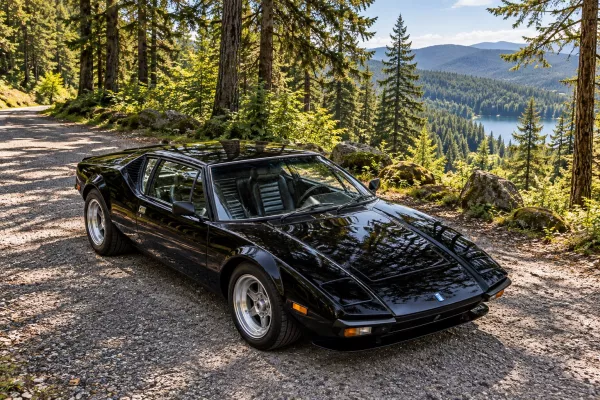
The Pantera was unveiled in 1970, with production beginning in 1971. Ford sold it in the United States through the Lincoln-Mercury dealer network until 1974. Yet the end of that partnership did not end the car's story. De Tomaso continued developing the Pantera for almost two more decades, from the relatively restrained original coupé through the wide-bodied GT5 and GT5-S to the extensively revised Si of the early 1990s. That unusually long production life means the Pantera is best understood as a family of evolving versions built around one fundamental design, rather than as a car with a single, unchanging specification.
From the Vallelunga and Mangusta to the Pantera
Alejandro de Tomaso, an Argentine racing driver who established his career in Italy, founded his company in Modena in 1959. Its early activities centred on racing machinery. The first De Tomaso road car, the Vallelunga, paired a mid-engined layout with a four-cylinder Ford engine. The subsequent Mangusta introduced a larger V8 and striking bodywork designed by Giorgetto Giugiaro. But it was not an obvious candidate for a major American sales programme: it was cramped and demanding, and its chassis imposed considerable compromises.
The Mangusta used a distinctive central structural member. Its weight distribution and suspension geometry left a limited margin for error in fast driving. De Tomaso needed something more mature, capable of retaining the drama of an engine mounted behind the occupants while offering a roomier cabin and more predictable handling. The new car also had to be manufactured in quantities beyond the usual output of a small Italian specialist.
Ford, meanwhile, wanted a product that would strengthen the image of the corporation and its Lincoln-Mercury division. Lee Iacocca saw the appeal of an Italian sports car that could be sold with the backing of an American dealer network. The arrangement promised to bring into Lincoln-Mercury showrooms customers who would not normally have considered a large sedan or luxury coupé. Compared with other European supercars, the Pantera was intended to be more attainable, while its series-production Ford engine would simplify at least part of the servicing burden.
An agreement reached in 1969 brought together two very different approaches to manufacturing. The Italian side contributed design, chassis expertise and the physical architecture of the car. The American partner supplied the engine, capital, a need for higher volume and the demands of its domestic market. In 1970 Ford acquired controlling interests in companies involved in the programme, including the Ghia and Vignale operations. The resulting tension between rapid market entry and the realities of low-volume vehicle quality would become a defining part of the Pantera's history.
From prototype to production car
The Pantera's exterior was the work of Tom Tjaarda, an American designer at Ghia. Major chassis engineering work is associated with Giampaolo Dallara, who had previously worked at Lamborghini. This was therefore more than an American engine installed in an existing Italian body. The proportions, steel structure and powertrain packaging were developed together for the requirements of the new car.
The prototype, identified in project documentation as Tipo 874, was shown in Italy in March 1970. The Pantera appeared at the New York Auto Show shortly afterwards. Its wedge profile, long and low front deck and broad rear body captured the styling direction of the new decade. It looked uncompromisingly sporting, even though everyday road use was part of the original brief.
Production began in 1971. Manufacturing the car was more complicated than the idea of an Italian sports car sold by Ford might suggest. Bodies were produced by Vignale in Turin, while much of the final assembly was carried out in Modena. Some early cars were completed entirely at Vignale. As output increased, Ford attempted to introduce more consistent production processes and quality control, although the steel bodywork still involved substantial manual labour.
Suppliers also imposed limits. The five-speed ZF transaxle was a specialist component, and increasing its production was not as straightforward as obtaining more examples of a mass-produced Ford V8. The ambitious volume originally envisaged by Ford was never fully achieved. Even so, the Pantera was built in exceptionally large numbers by De Tomaso standards and rapidly became the marque's most important model.
A steel monocoque in place of the Mangusta's backbone
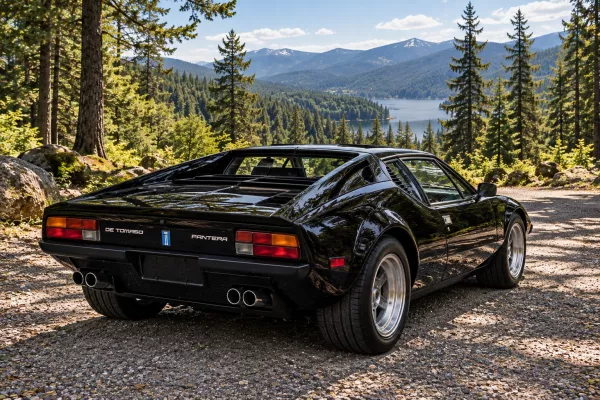
The Pantera's most important structural advance over the Mangusta was hidden beneath its bodywork. It adopted a steel monocoque, integrating the load-bearing structure and body rather than relying on the earlier car's separate backbone-type arrangement. This promised more efficient packaging, more consistent assembly and a rigid foundation for the suspension.
Its layout remained that of a conventional mid-engined sports car: two occupants sat ahead of a longitudinally mounted V8, with drive delivered exclusively to the rear wheels. The gearbox and differential formed a transaxle mounted behind the engine. That arrangement kept the powertrain concentrated towards the rear without the need for a long propeller shaft.
Steel construction came at a cost in mass. The Pantera was not particularly light when measured against some of its more extreme European rivals. In a 1971 test, Car and Driver weighed its example at approximately 1,417 kg, with 59.1 per cent of the weight over the rear axle. That figure helps explain both the traction available when accelerating from rest and the care required when the load on the rear tyres changed abruptly in a corner.
All four wheels were independently suspended using unequal-length wishbones, coil springs, dampers and anti-roll bars. Compared with the suspension systems of typical American performance cars of the period, this was a sophisticated arrangement. Rack-and-pinion steering could communicate front-tyre grip directly, but the steering effort, especially at low speeds, was demanding. Early cars used disc brakes at both ends, with details of their design and cooling changing as the model developed.
Ford's V8: generous displacement, familiar engineering and misleading power figures
Behind the passenger compartment sat the Ford 351 Cleveland, a naturally aspirated V8 of roughly 5.8 litres. The designation 351 refers to its capacity in cubic inches. Its camshaft was mounted in the engine block, operating two valves per cylinder through pushrods. At a time when European sports-car manufacturers were increasingly using overhead camshafts, the layout seemed conservative. In practice, it offered a relatively straightforward mechanical package, considerable strength and abundant torque without needing very high engine speeds.
The engine's power delivery gave the Pantera much of its distinctive character. In a Ferrari with a high-revving twelve-cylinder engine, the driver often had to seek out the upper reaches of the rev counter. The Ford V8 could accelerate hard from the middle of its operating range. Combined with a five-speed ZF 5DS-25 gearbox and a limited-slip differential, it made the Pantera more flexible in everyday use than its extremely low body might suggest.
Published power figures demand particular care. Early American Panteras are variously associated with outputs of approximately 310 and 330 hp, equivalent to roughly 314 and 335 metric horsepower respectively when only the units are converted. The car tested by Car and Driver in 1971 was described as producing 310 hp under the contemporary SAE gross standard. That method rated an engine under conditions different from the later and more representative SAE net system. Early-1970s brochures also varied by market, engine version and rating convention. Simply placing these historical numbers alongside modern horsepower figures would produce a misleading comparison.
Tightening American emissions legislation, fuel requirements and changing test standards affected later engines. The 1973 car tested by Motor Trend was rated at 266 hp SAE net, equivalent to approximately 270 metric horsepower as a unit conversion. The difference from earlier advertised outputs cannot be described solely as a mechanical loss of several dozen horsepower: the rating systems were different as well. European versions, especially the GTS, could retain higher compression ratios and sportier engine tuning, and factory literature sometimes credited them with about 350 metric horsepower. Such numbers need to be attached to a specific market and model year.
The Ford engine offered one enduring practical benefit. Its mass-production origins made many mechanical parts easier to obtain and provided considerable scope for repairs and modifications. But that did not make the entire Pantera inexpensive to own. The ZF transaxle, body components, cooling arrangements and suspension details remained specialist items, and access to parts of the engine could be difficult in the confined space behind the cabin.
Performance through the eyes of contemporary road testers
The Pantera attracted attention because it appeared to offer the looks and speed of cars costing substantially more. In 1971 its American price was around $9,800-10,000. That was still a considerable sum, but well below the asking prices of many limited-production Italian exotics. In an instrumented test, Car and Driver recorded a standing quarter-mile time of 14.0 seconds, crossing the line at approximately 160 km/h. A separate Motor Trend test of a revised 1973 car measured 0-60 mph, or approximately 0-97 km/h, in 6.6 seconds. These are results from different versions and conditions, not directly interchangeable with manufacturer claims for other model years.
For early Panteras, factory information and period publications quoted maximum speeds in the region of 250-260 km/h. One figure should not be applied to every derivative. Engine output, gearing, aerodynamic details and equipment changed during production. European sporting versions carried higher published claims, but they were not identical to the emissions-compliant cars sold in American dealerships.
Driving behaviour drew more nuanced responses than straight-line performance. Car and Driver praised the car's directional accuracy at speed and the effectiveness of its brakes, while warning about a sudden transition into oversteer when the throttle was lifted during cornering. The car could initially feel understeer-prone and then change attitude unexpectedly. Suspension geometry, tyres, weight distribution and driver inputs all influenced that reaction. Merely locating the engine ahead of the rear axle does not guarantee forgiving handling.
Nor should lift-off oversteer be attributed in exactly the same way to every surviving Pantera. Cars today use different tyres, suspension geometry settings, springs and dampers, and many have been extensively altered by their owners. A contemporary road test chiefly records the behaviour of a particular early specification on the tyres and roads of its time.
Tjaarda's design and a cabin dictated by the silhouette
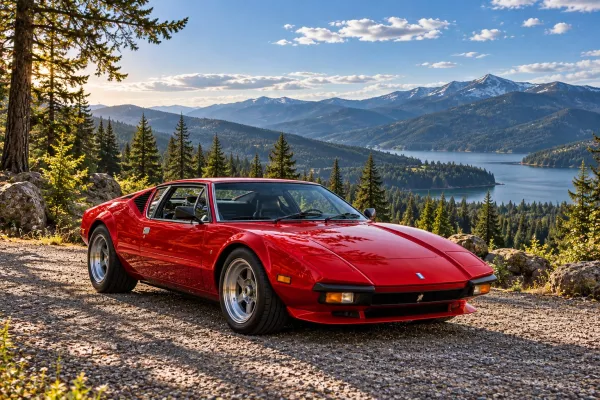
The Pantera is an especially clear expression of the wedge-shaped sports-car design of the 1970s. A low nose, pop-up headlamps, a broad cabin and substantial rear wings create a form largely free of unnecessary curves. The surfaces of the earliest version are relatively restrained. Unlike some more theatrical designs of the decade, Tjaarda did not need an abundance of vents or aerodynamic attachments to make the shape visually dramatic.
The side profile reveals the logic of its packaging. The short rear overhang concealed the transaxle and exhaust components, the passenger cell was pushed forward, and the air intakes served the engine mounted directly behind the seats. Yet the low roof and large, steeply raked windscreen also restricted ventilation and instrument placement.
From outside, the Pantera looked like an uncompromising racing machine. Inside, De Tomaso attempted to accommodate expectations of American customers, including such features as electric windows and air conditioning, although availability and effectiveness differed across model years. The driver sat low within the wide body. Instruments were divided between the main binnacle and the centre console, near the distinctive gear lever moving through a metal shift gate.
Ergonomics did not always match the visual ambition. The front wheel arches intruded into the footwells, displacing the pedals in relation to the steering wheel and leaving the driver's legs in an asymmetric position. Early tests criticised the steering wheel's distance from the seat, the visibility of some instruments and the amount of heat entering the cabin from sunlight and the engine compartment. Luggage could be carried in the available storage spaces, but extended travel with several large cases was hardly one of the car's strengths.
The Pantera nevertheless offered easier access and a roomier interior than the Mangusta. That was real progress for De Tomaso, even if the car remained far removed from the comfort of a conventional grand tourer. Its aim was to combine everyday usability with sports-car performance, but the result was a compromise. Exhaust noise, heat and awkward access to the mechanical components remained constant reminders of its specialist origins.
The early years: quality problems and running improvements
The speed with which production was launched contributed to its early difficulties. Cars reached American showrooms with finish and reliability below the expectations of customers accustomed to dealing with a major manufacturer. Complaints included weak cabin ventilation, inconsistent panel fit, failures of minor electrical equipment and cooling problems. Concerns were also raised about welds in the rear structure. According to a historical account published by Pantera International, Ford carried out remedial work on cars already delivered to America, while the first 94 cars sold were covered by a voluntary recall.
Corrosion protection proved particularly important in the longer term. The steel monocoque contained enclosed areas that were difficult to dry, and its protection against rust was not always sufficient for decades of exposure. In damp climates, especially where roads were salted, corrosion could spread from inside structural sections while remaining invisible beneath the paint. Today, the condition of the body structure can matter far more than that of the comparatively familiar Ford engine.
The initial changes in engineering and manufacturing were intended to bring the Pantera closer to the standards expected of a Lincoln-Mercury product. Assembly procedures, cooling, wiring and body details received attention. Not every problem disappeared. Later bumper and emissions requirements also complicated a car originally conceived around a light, sharply defined body shape.
That history helps explain why Pantera owners often regard well-documented mechanical upgrades differently from collectors of some other classics. An improved cooling system, correctly repaired wiring or properly protected steel structure can make the car easier to use. The quality of the work is decisive, however. Poorly executed modifications introduce new faults, while the loss of original components can make a historically correct restoration much more difficult.
Pantera L and the two different meanings of GTS
The Pantera L appeared in the latter half of 1972, with the L standing for Lusso. Primarily intended to meet American requirements and improve day-to-day quality, it gained larger bumpers, revised interior and exterior details and a package of ongoing refinements. It was not a new generation, but the next development stage of the original car. The more substantial protective bumpers are its most obvious visual distinction, though they compromise some of the lightness of Tjaarda's early design.
At about the same time, De Tomaso developed a GTS for the European market. It had a more aggressive appearance, sportier tyre and chassis specifications, and an engine that could use a higher compression ratio and different tuning. Factory literature quoted power figures in the region of 350 metric horsepower, although actual equipment depended on country, production date and individual order. The European GTS appealed to buyers who valued direct performance more highly than the American version's attempts at greater comfort.
A GTS-badged Pantera was also offered in the United States in 1974. The shared name can be deceptive. The American package was largely cosmetic and did not include the complete mechanical specification of the European GTS. When studying a brochure, evaluating a surviving car or researching its history, the intended market therefore matters. A badge on the wing does not establish the engine or suspension specification.
The break with Ford
The oil crisis erupted in the autumn of 1973. A thirsty, visually conspicuous sports car with a large V8 suddenly fitted the market much less comfortably. Ford also faced tightening safety and emissions legislation, while the Pantera continued to demand investment in manufacturing quality and engineering. From a major corporation's perspective, the prospects for a relatively small programme had become less attractive.
Ford ended regular Pantera imports and sales after the 1974 model year. Cars already built or held in inventory could be registered later, helping explain the conflicting dates sometimes given for the end of its American presence. This was not, however, the liquidation of De Tomaso. Ownership arrangements and production rights changed, while Alejandro de Tomaso continued operating under his own marque.
The original production ambitions had not been met. Estimates of roughly 5,500 cars sold in the United States coexist with larger figures referring to cars imported or built during the Ford partnership. Those are different measures. An imported car is not necessarily a retail sale, and the number of manufactured bodies need not equal the number of completed cars delivered to customers.
Paradoxically, Ford's departure allowed one of the most interesting chapters of the Pantera story to begin. De Tomaso could continue developing the existing design around the needs of a small specialist manufacturer. It no longer had to build cars for an extensive American dealer network. Output could fall dramatically, while European customers could order more individual configurations. The price of that freedom was the loss of scale, dependable large-volume purchasing and support from a much larger industrial partner.
A second life after the Ford partnership
The Pantera did not disappear after 1974. Initially, De Tomaso could make use of stocks of bodies previously produced by Vignale. Later, body manufacture was entrusted to other Italian firms, including Maggiora and subsequently Embo. These changes help explain differences in construction details between later examples, and why information about the earliest American cars cannot automatically be applied to all European Panteras.
Engine supply also demanded flexibility. After American production of the Cleveland engine ended, engines of that family continued to be manufactured in Australia and supplied for later Italian cars. Ford Windsor-family engines of 351 cubic inches also appeared towards the end of production of the older Pantera versions. Identical nominal displacement does not mean identical engineering. The Cleveland and Windsor differ in areas including their blocks and cylinder heads, distinctions that matter for servicing and determining whether a car retains its correct factory configuration.
The low-volume cars of the late 1970s and 1980s moved increasingly far from the original concept of an accessible supercar. Sales relied on the familiar silhouette and the chance to order something individual. Among enthusiasts, the Pantera acquired a second identity through competition use, extensive tuning and the relative accessibility of Ford engine parts.
Years of road and track use exposed the design's weaknesses but also encouraged effective solutions. There was never one universally accepted factory recipe for the ideal Pantera. Surviving cars range from original examples to accurately restored vehicles and heavily modified machines. Keeping those categories separate is essential when examining the history of the model.
GT5 and GT5-S: the era of wide arches
By the end of the 1970s, wide, low-profile tyres were changing the proportions of supercars. Italian manufacturers were adopting substantial wheel-arch extensions, spoilers and more elaborate lower bodywork. The Pantera followed the same direction. GTS versions with racing-inspired flared arches appeared first; the GT5 designation then became established. The GT5 emerged as a distinct and recognisable derivative around 1980.
The GT5 featured a substantial lower front spoiler, extended sills and enlarged wheel arches, together with extremely wide wheels and a prominent rear wing. The characteristic extensions were made from composite material and attached to the steel body. Changes to brakes, tyres and cabin equipment accompanied the visual transformation. Underneath, this remained a further development of the familiar mid-engined V8 car rather than an entirely new design.
The presence of a large rear wing does not, by itself, establish a particular downforce figure for a GT5. Without comparable aerodynamic test data, it is more accurate to regard the wing as both a styling feature and part of the overall body package, rather than transferring racing-car aerodynamic claims to the road model. Wider tyres did directly affect the car's grip and handling responses, although they also increased running costs and dependence on the availability of appropriate sizes.
The GT5-S succeeded the GT5 in the mid-1980s. Its key distinction was the use of widened steel wings integrated into the bodywork, rather than separately attached composite extensions. The resulting silhouette appeared more cohesive, although it remained a long way from the restraint of the original car. The nose, interior, air conditioning and trim were also revised. Leather upholstery, wood detailing and individually specified equipment reflected the model's increasingly exclusive position.
Both versions were made in small quantities. The boundaries between years and derivatives are not always completely clear: individual cars could be completed to order after a newer version was introduced, and subsequent owner modifications further complicate identification. A wide-bodied Pantera should not therefore be described as a factory GT5 or GT5-S on appearance alone without examining its chassis identity and history.
Pantera Si: the final major redesign
In 1990, De Tomaso presented a substantial update known as the Pantera 90 Si, usually shortened to Pantera Si. Marcello Gandini was responsible for the revised styling. He retained the essential mid-engined proportions while redesigning the nose, lower bodywork, aerodynamic attachments and details of the rear. It was an unusual case of a car identified so closely with one designer receiving an extensive restyling almost two decades later from another major name in Italian automotive design.
The work extended well beneath the surface. Elements of the structure and suspension were strengthened or redesigned, including more elaborate tubular components at the rear. Nevertheless, the proper starting point for describing the car is still a steel monocoque with additional rear structural elements. It would be misleading to call every Pantera Si an entirely new car built on a spaceframe. Larger ventilated Brembo brakes and contemporary tyres mounted on 17-inch wheels were also introduced.
The Si was powered by a smaller Ford V8 with a capacity of 4,942 cm³, belonging to the 302/5.0 family and equipped with electronic fuel injection and catalytic converters. Specialist specifications quote approximately 304 hp, or about 308 metric horsepower as a direct unit conversion. That rating belongs to a very different technical and measurement context from the figures published for the first Panteras. The five-speed ZF remained the principal gearbox. Club documentation indicates that a very small number of cars received a six-speed Getrag transmission.
The update was connected in part with proposals to return to the American market. Fuel injection and catalytic converters alone could not satisfy every federal requirement, particularly those related to passenger protection and vehicle safety. Regular American sales were not resumed.
Production estimates generally indicate about 41 Pantera Si examples, although published accounts differ in whether they count all completed cars or those actually delivered to customers. A handful received a removable centre roof panel. The last period of production falls in the early 1990s, commonly described as ending in 1992 or 1993 depending on whether the date refers to assembly or final deliveries.
On the circuit: Group 3, Group 4 and Le Mans
Alongside the road-car programme, De Tomaso and private teams developed Panteras for competition. Important GT racing derivatives included Group 3 and the more extensively modified Group 4. Both started from the Pantera concept but incorporated changes to the engine, suspension, bodywork, cooling and equipment to meet the relevant regulations. Their specifications should never be confused with those of a Pantera L or road-going GTS.
Racing cars used flared arches, very wide wheels, upgraded brakes and measures intended to control temperatures during prolonged high-load running. The large Ford V8 gave them a strong starting point, but circuit use also demanded work on the limitations of weight distribution, structural stiffness, cooling and gear ratios.
The Pantera competed in the 24 Hours of Le Mans. At the 1972 event, a Group 4 entry from Claude Dubois, driven by Jean-Marie Jacquemin and Yves Deprez, finished 16th overall. A second Group 4 Pantera entered that race but did not finish. The result was not a Le Mans victory, yet it establishes that the Pantera had a genuine competition career rather than merely racing-inspired road-car styling.
There were also victories in European GT events. Racing records include Herbert Müller's win at Nivelles in 1972 and Pantera appearances at circuits such as Spa, Monza, Imola and the Nürburgring. This was primarily the story of smaller teams and private drivers, not a dominant, heavily funded factory campaign on the scale of the largest racing programmes of the period.
Competition also influenced the look of the later road cars. The widened arches and large tyres of the GT5 echoed solutions developed for racing variants. In that sense, racing was more than a minor chapter in Pantera history: it helped shape the model's second, more aggressive identity.
How many Panteras were actually made?
A frequently repeated total is approximately 7,260 cars. It is useful as an indication of the programme's scale, but it should not be presented as an undisputed count of every completed example. Club registers and attempts to reconstruct production from chassis numbers produce somewhat different totals. The differences stem partly from how early Ford-era cars, later bodies supplied by independent coachbuilders, racing examples and the final Si cars are counted.
The broader picture is much clearer. The great majority were built during the initial years, when the United States provided a large dealer network. Annual production fell sharply after the end of the Ford relationship. By the 1980s the Pantera was a specialist product, assembled in small numbers for customers who accepted its individual character.
It was De Tomaso's greatest production success, but it also illustrated the limitations of the original industrial alliance. Ford gave the Pantera its international visibility, and the car then survived without Ford's direct sales support. Its production volume far exceeded that of the earlier Mangusta, yet it never became a permanent fixture of the American performance-car market.
Ownership, restoration and the risk of misidentifying a version
Much of the Pantera's appeal today comes from a combination difficult to find in more recent cars: Italian bodywork, a mid-mounted V8, a mechanical five-speed gearbox and the relative serviceability of its basic Ford engine. The last point can be overstated. An engine rebuild does little to solve corroded sills or a damaged rear body structure, while repairs to unusual body panels call for appropriate expertise.
Evaluating a surviving car requires checking chassis numbers and documents confirming the variant, production period and original market. A car with flared arches may be a factory GT5, a later conversion of an ordinary Pantera or a vehicle assembled with parts from several derivatives. Many early Panteras have also acquired stronger engines, different brakes, newer wheels and modified cooling systems over the decades. None of these changes automatically determines the car's value, but all should be described accurately.
The monocoque makes it particularly important to inspect for corrosion, poorly repaired accident damage and improvised strengthening around suspension mounting points. Mechanically, the condition of the ZF gearbox, driveshafts, bearings, cooling circuit and fuel system matters, as does the engine's consistency with the documented factory specification. Correct tyres and suspension alignment have a major effect on handling. A car left standing for years may require as much remedial work as an intensively driven example.
Early cars retaining their original specification, genuine GTS derivatives, the dramatic GT5 and GT5-S, and the exceptionally scarce Si appeal to different collectors. There is no single representative Pantera price. Structural condition, authenticity, modification history, restoration quality and documented provenance matter more than model year alone. One exceptional auction result for a rare derivative does not describe the market as a whole.
The Pantera in popular culture
Perhaps the best-known story concerns Elvis Presley. The musician owned a yellow 1971 Pantera that later entered the Petersen Automotive Museum collection in Los Angeles. The car retains bullet damage, and a widely repeated account says Presley fired a pistol at it when it refused to start. Published versions of the surrounding circumstances differ, however. The existence of the car and the damage is well documented; the precise sequence of events should not be presented with the certainty of a contemporary incident report.
The anecdote also says something about the Pantera's American image. Its appearance was thoroughly exotic, yet its mechanical calling card came from a domestic manufacturer. For many buyers it offered the reassuring prospect of an Italian supercar whose engine parts might be found closer to home than those for a Ferrari or Lamborghini. Everyday ownership revealed how much of the rest of the vehicle remained distinctly low-volume and Italian.
The Pantera also endured because it became a favourite starting point for individual projects. The mechanical simplicity of the V8 encouraged power upgrades, while the strong original shape invited widened arches, lowered suspension and alternative wheels. Cars encountered at enthusiast gatherings can consequently differ from the original brochures far more than many other classics of the same era.
Legacy: a successful idea that never became a completely resolved product
The De Tomaso Pantera achieved much of what its creators set out to do. It demonstrated that an Italian mid-engined sports car could be manufactured in the thousands and distributed through an extensive American dealership network. Ford's involvement allowed it to sell at a substantially lower price than the most exclusive European machinery, while still delivering performance that justified the shape.
What remained unfulfilled was the promise of an exotic car entirely freed from the difficulties of small-scale manufacturing. Rushed development, inadequate corrosion protection, cooling problems and ergonomic compromises limited its everyday practicality. Ford did not remain involved long enough to move the programme into a further phase of large-scale development. De Tomaso nevertheless continued adapting the underlying engineering with unusual persistence.
The Pantera ultimately became something more distinctive than a less expensive alternative to Ferrari or Lamborghini. It was the product of a rare meeting between American engine manufacturing, Italian coachbuilding and specialist sports-car engineering. The partnership between an industrial giant and a small manufacturer produced a car full of contradictions, yet immediately recognisable. From Tjaarda's clean original wedge to Gandini's final Si, the central idea survived: a V8 directly behind the driver, a mechanical connection to the rear wheels and a shape unlike any conventional American coupé of its day.