De Tomaso Pantera
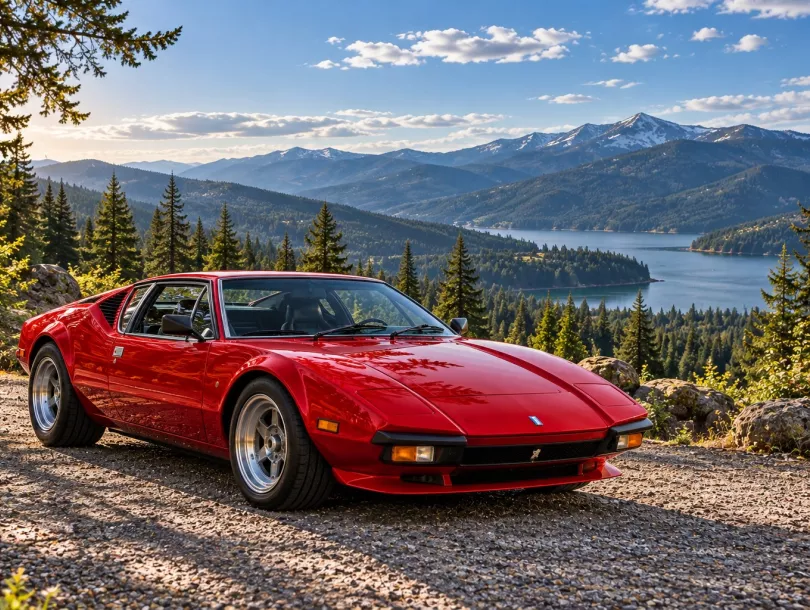
The De Tomaso Pantera debuted in 1970 as the successor to the Mangusta. Designed by Tom Tjaarda at Ghia, the mid-engine sports car replaced its predecessor's backbone frame with a steel monocoque chassis, combining sharp Italian styling with American muscle car hardware.
Power came from a mid-mounted 5.8-liter (351 cubic-inch) Ford Cleveland V8 paired with a ZF five-speed manual transaxle. Through a commercial partnership with Ford Motor Company, the Pantera was sold in the United States through Lincoln-Mercury dealerships, offering buyers supercar proportions with readily available domestic engine parts. Over a production run lasting from 1971 to 1993, De Tomaso built more than 7,000 units, establishing the Pantera as the brand's most successful and recognizable model.
Related articles
Key specifications
Differences between variants
| Specification | De Tomaso Pantera | De Tomaso Pantera GTS | De Tomaso Pantera GT5-S |
|---|---|---|---|
| Power | 246.08 kW | Up to 260.99 kW | Up to 260.99 kW |
| Production period | 1971-1974 | 1972-1985 | 1985-1992 |
Generations and variants
De Tomaso Pantera
De Tomaso Pantera
1971-1974- Body style
-
Coupe
- Engine
- 5.8 l · Naturally aspirated · V8
- Power
- 246.08 kW
- Drivetrain
-
Rear-wheel drive
- Transmission
-
Manual· 5 speeds
De Tomaso Pantera GTS
1972-1985- Body style
-
Coupe
- Engine
- 5.8 l · Naturally aspirated · V8
- Power
- Up to 260.99 kW
- Drivetrain
-
Rear-wheel drive
- Transmission
-
Manual· 5 speeds
De Tomaso Pantera GT5-S
1985-1992- Body style
-
Coupe
- Engine
- 5.8 l · Naturally aspirated · V8
- Power
- Up to 260.99 kW
- Drivetrain
-
Rear-wheel drive
- Transmission
-
Manual· 5 speeds
Facts
The Pantera used fully independent double-wishbone suspension.
The Pantera's engine was paired with a five-speed ZF transaxle driving the rear wheels.
The early Pantera used a mid-mounted Ford 351 Cleveland V8 of about 5.8 litres.
Unlike earlier De Tomaso road cars with backbone frames, the Pantera used a steel unibody structure.
The Pantera family remained in production for 23 years, evolving through numerous revisions and derivatives.
By the end of Ford's involvement in 1974, 6,091 Panteras had been imported into the United States.
The Pantera was shown in Modena in 1970 and then presented to the American public at the New York auto show.
The Pantera's body was designed by Tom Tjaarda while working at Ghia.
Gianpaolo Dallara worked on the Pantera's chassis and engineering development.