Pagani
Pagani Automobili was founded in 1992 in San Cesario sul Panaro, near Modena, Italy, by Argentine-Italian engineer Horacio Pagani. After managing Lamborghini's composites department - where he pioneered the early use of carbon fiber on projects like the Countach Evoluzione - Pagani established his own boutique manufacturer to pair high-performance engineering with meticulous artistic craftsmanship.
The brand made its public debut at the 1999 Geneva Motor Show with the Zonda C12, introducing a signature design language centered on a central quad-pipe exhaust array and bespoke Mercedes-AMG V12 engines. Pagani followed the Zonda in 2011 with the Huayra, which introduced active aerodynamic flaps and a carbo-titanium composite chassis. In 2022, the company launched its third core model line, the Utopia, pairing a twin-turbo V12 with an available manual transmission and a deliberate focus on analog driver feedback over heavy hybrid hardware.
Operating from its atelier in Emilia-Romagna, Pagani limits vehicle output to small annual batches, giving clients extensive scope for custom tailoring. The company maintains its exclusive engine partnership with Mercedes-AMG while remaining an independent, family-controlled hypercar builder.
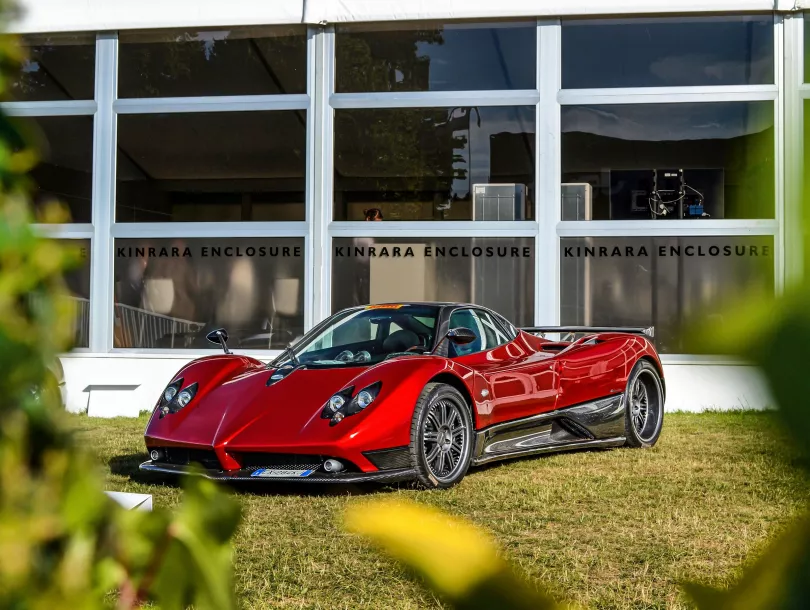
Models over time
Pagani Zonda
Pagani Huayra
Pagani Imola
Pagani Utopia
Data
Facts
The Utopia monocoque is made from Carbo-Titanium HP62 G2 and Carbo-Triax HP62, with chromium-molybdenum steel tubular subframes.
The Utopia can be specified with a true seven-speed manual or a transverse seven-speed automated-manual transmission, both developed with Xtrac.
The Pagani Utopia has a stated dry weight of 1,280 kg.
The Utopia produces 1,100 Nm of torque from 2,800 to 5,900 rpm.
The Utopia engine produces 864 hp (635 kW) at 6,000 rpm.
The Utopia uses a bespoke 60-degree 5,980 cc twin-turbo V12 developed by Mercedes-AMG for Pagani.
The Imola structure uses Pagani Carbo-Titanium HP62 G2 and Carbo-Triax HP62 monocoque materials with tubular steel subframes.
The Imola uses ventilated Brembo carbon-ceramic brakes: 398 × 36 mm discs with six-piston calipers at the front and 380 × 34 mm discs with four-piston calipers at the rear.
The Imola uses a transverse seven-speed Xtrac automated-manual transmission with an electromechanical differential.
The presentation specification of the Pagani Imola had a stated dry weight of 1,246 kg.
More facts about Pagani
Showing 11–20 of 40 facts