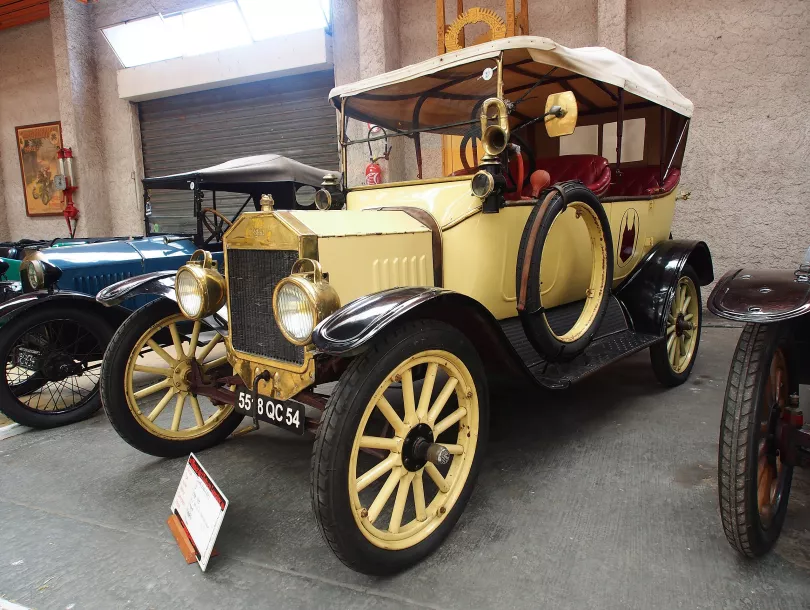
Ford Model T
Key specifications
Differences between variants
| Specification | Ford Model T Runabout | Ford Model T Touring |
|---|---|---|
| Body style | Runabout | Touring car |
| Production period | Not recorded | 1908-1927 |
Generations and variants
Ford Model T - 1908-1927
Ford Model T Runabout
- Body style
-
Runabout
- Engine
- 2.9 l · Inline 4
- Power
- 14.91 kW
- Drivetrain
-
Rear-wheel drive
- Transmission
-
Other transmission· 2 speeds
Ford Model T Touring
1908-1927- Body style
-
Touring car
- Engine
- 2.9 l · Inline 4
- Power
- 14.91 kW
- Drivetrain
-
Rear-wheel drive
- Transmission
-
Other transmission· 2 speeds
Facts
The Henry Ford's 1919 Model T uses a 177-cubic-inch L-head inline-four rated at 20 hp.
Throughout its 1908-1927 production run, the Model T used a two-speed planetary transmission; its gears remained constantly meshed, making shifts easier than with contemporary unsynchronized sliding-gear transmissions.
Ford designed the Model T to be reliable and comparatively easy to maintain and repair, an important quality for owners far from workshops.
Ford used light, strong vanadium-steel alloy in critical Model T parts to improve durability on the primitive roads of the period.
In 1999, an international jury of motoring journalists and industry experts selected the Ford Model T as the “Car of the Century.”
After Model T production ended, Ford closed many plants for roughly six months to retool for its successor, the Model A.
In 1908, the United States had only about 18,000 miles of paved roads, making the Model T's ability to cope with poor surfaces an important design requirement.
The first Ford Model T was delivered to a customer on October 1, 1908.
The first roughly 2,500 Model Ts used a gear-driven water pump, but Ford later switched to a simpler thermosiphon cooling system.
An electric starter first became available on the Model T in 1919, along with a generator in the electrical system.