The Ferrari Purosangue is a car Maranello spent years resisting the temptation to call an SUV, even though in market terms it competes for much the same customers as the Lamborghini Urus, Aston Martin DBX and the most powerful Porsche Cayenne variants. Ferrari prefers to describe it as a four-door, four-seat sports car with a raised body. The argument over terminology matters less than the way the company approached the engineering problem. Purosangue was not built on a group SUV platform, and it does not use a turbocharged V8 shared with another marque. It has its own aluminium-intensive structure, a naturally aspirated V12 mounted in a front-mid-engine position, a rear transaxle, a separate transmission for the front wheels, and a 48 V active suspension system powerful enough to replace conventional anti-roll bars.
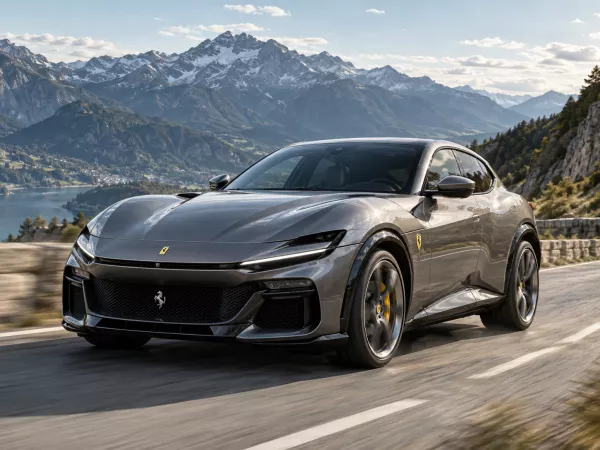
Ferrari unveiled the production car on 13 September 2022 in Lajatico. It became the first series-production Ferrari with four doors and four full-size seats. The company had a long history of 2+2 grand tourers before it, and the FF and GTC4Lusso already combined four seats, a large rear hatch and all-wheel drive, but access to the rear still depended on a single pair of side doors. Purosangue changed that arrangement completely. Its rear doors are rear-hinged, the cabin is designed for four adults, luggage capacity is 473 litres, and the driving position is higher than in a conventional Ferrari.
Its most conservative component is also one of the most unusual choices in the modern high-performance luxury segment. Purosangue uses a 6.5-litre naturally aspirated V12 rated at 725 PS, with no hybrid system and no turbocharging. At the same time, its chassis is among the most electronically sophisticated Ferrari has fitted to a road car. That tension between a traditional engine and highly advanced vehicle-dynamics control is central to the Purosangue's character.
Ferrari's road to four doors
Ferrari has spent decades building cars intended for long-distance travel, often with a front-mounted V12 and extra seats behind the driver. The 250 GTE, 330 GT 2+2, 365 GT 2+2, 456 GT, 612 Scaglietti, FF and GTC4Lusso belong to different periods, but they share an important idea: a Ferrari does not have to be a two-seat berlinetta to function as a genuine grand tourer.
The FF, introduced in 2011, was a particularly important predecessor. It combined a shooting-brake body, four seats, a large tailgate and Ferrari's first series-production all-wheel-drive system. Instead of using a conventional centre differential, Ferrari fitted a compact front Power Transfer Unit, or PTU, driven directly from the front of the engine. The later GTC4Lusso developed that concept further and added rear-wheel steering.
Purosangue is not simply a taller replacement for the GTC4Lusso, but it carries forward several of the same fundamentals. It is still a V12 Ferrari with four seats and a rear hatch, intended to cover long distances at high speed. The difference lies in how far Ferrari pushed usability. A taller body, four side doors, increased ground clearance, easier entry and a broader set of systems for rain, snow and steep descents make it suitable for situations in which the earlier GTs demanded more compromise.
Ferrari began preparing the public for the project several years before the production reveal. At its Capital Markets Day in September 2018, then-CEO Louis Camilleri confirmed the Purosangue programme while pointedly distancing the company from the term SUV. At that stage the name was still associated mainly with the programme itself, but Ferrari ultimately retained it for the production model.
Enrico Galliera, Ferrari's chief marketing and commercial officer, later explained that "Purosangue" had originally been a project name intended to remind the team that the finished car had to remain unmistakably Ferrari. In Italian the word means thoroughbred, which naturally fits the marque's prancing-horse identity. In product terms, the name also helped Ferrari frame the car as something other than a conventional SUV designed primarily around maximum interior volume, a high seating position and off-road capability.
Launch and market positioning
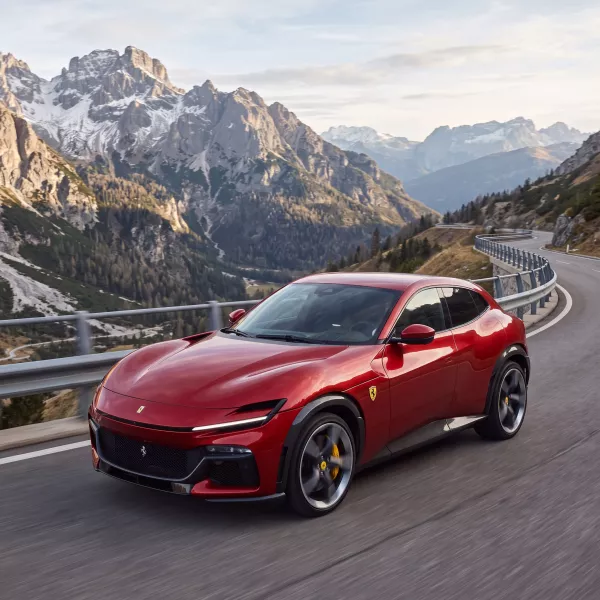
The world premiere took place in September 2022, during Ferrari's 75th-anniversary year. The company emphasised that Purosangue was the first four-door, four-seat car in its history. That did not mean Ferrari planned to turn it into a mass-volume line.
From the outset, management said Purosangue would remain below 20 percent of Ferrari's total deliveries over its lifecycle. The intention was to avoid the pattern seen at some luxury marques where an SUV quickly becomes the dominant product and reshapes the whole production mix around itself.
Demand was strong enough that Ferrari temporarily stopped taking new orders before regular customer deliveries had fully begun. In May 2023 the company said it had reopened the order book. Purosangue began reaching customers during 2023, and Ferrari later identified it as one of the models contributing to delivery growth in both 2023 and 2024. In the company's reporting for 2025, it was still listed among models in global distribution during 2026.
At launch, the Italian base price was around €390,000, although actual transaction prices vary heavily by country, taxes and personalisation. In the United Kingdom the initial list price exceeded £313,000 and later rose. In this part of the market, the final cost of a well-optioned car can move far beyond the nominal base price, so comparing entry prices alone gives only a limited picture.
A dedicated architecture rather than a shared SUV platform
The most important technical decision concerned the layout of the powertrain. Most high-performance luxury SUVs place the engine ahead of the cabin with the gearbox mounted directly behind it. That makes packaging easier and suits conventional all-wheel-drive hardware, but it is not ideal for weight distribution.
Ferrari instead used a layout familiar from its front-engined sports cars. The V12 sits in a front-mid-engine position, with much of its mass behind the front axle line. The eight-speed dual-clutch gearbox is mounted at the rear as a transaxle. Ferrari quotes a static weight distribution of 49 percent front and 51 percent rear.
The front axle is not driven by a conventional transfer case attached to the rear gearbox, nor by a long secondary propshaft returning power to the nose of the car. Instead, Ferrari mounts a compact Power Transfer Unit ahead of the V12. The PTU takes drive from the front of the crankshaft and, through its own ratios and controlled clutches, can send torque to the front wheels. The idea descends from the FF and GTC4Lusso, but Purosangue uses an evolved version known as 4RM-S evo.
This arrangement has several consequences. It keeps the heaviest mechanical components closer to the centre of the car, preserves a strongly rear-biased dynamic character, and allows the front axle to be used selectively for traction and stability rather than as a permanently equal partner. The PTU also has its own ratio and speed limitations. It contributes drive in the lower gears of the main transmission, while at higher road speeds the car effectively behaves as a rear-wheel-drive vehicle.
That is an important distinction from a conventional full-time AWD system. Purosangue does not aim to maintain a fixed front-to-rear torque split. The front axle is used when it can improve traction, stability or torque-vectoring behaviour.
F140IA V12: a traditional engine in an unusual application
The engine carries the F140IA code and belongs to Ferrari's long-running family of naturally aspirated V12s. It displaces 6,496 cm³, uses a 65-degree bank angle, dry-sump lubrication and direct fuel injection. Bore is 94 mm, stroke 78 mm, and compression ratio 13.6:1.
Maximum output is 725 PS at 7,750 rpm, equivalent to about 533 kW. Ferrari notes that the official figure includes an additional 5 PS attributed to ram-air effects under appropriate airflow conditions. Peak torque is 716 Nm at 6,250 rpm, with around 80 percent available from roughly 2,100 rpm. The engine rev limit is 8,250 rpm.
On paper, Purosangue does not try to out-muscle turbocharged rivals through low-rpm torque. Cars such as the Aston Martin DBX 707 and Lamborghini Urus produce more torque earlier, which can make them feel more forceful under partial throttle and in the middle of the rev range. Ferrari chose a different character. Power rises progressively, throttle response is not filtered through turbocharger boost, and extracting the engine's full performance means using high revs.
The cylinder heads use technology related to the 812 Competizione, but Ferrari redesigned elements including the intake, exhaust and calibration for Purosangue. The goal was to create a broad usable torque curve without sacrificing the high-revving nature of the V12. In practice, the engine is intended to remain smooth and tractable at motorway speeds while still rewarding a multi-gear downshift before an overtake.
Choosing a naturally aspirated V12 was also a deliberate product decision. By the time Purosangue arrived, Ferrari was already developing and selling hybrid models such as the SF90 and 296, while its direct rivals in the high-performance SUV segment relied mainly on turbocharged V8 engines. Purosangue instead received the most traditional engine format in the Ferrari range. It is not an efficient solution in fuel-consumption terms, but it gives the car a mechanical and acoustic identity that is very different from its competitors.
Eight-speed gearbox and the way 4RM-S evo works
The main transmission is an eight-speed F1 dual-clutch gearbox mounted at the rear axle. It belongs to the same broad generation of dual-clutch hardware used in newer Ferraris such as the SF90 Stradale and 296 GTB. In Purosangue, Ferrari chose closely spaced lower gears for acceleration and a taller eighth ratio for sustained high-speed cruising.
The front PTU operates independently of the rear transaxle, but its two ratios are coordinated with the first four gears of the main gearbox. In simplified terms, the first PTU ratio corresponds to the lowest rear-gear ranges and the second to the next pair. Once the main transmission selects fifth gear, the front axle no longer contributes propulsion.
The system is more sophisticated than simply engaging the front wheels after slip has already begun. 4RM-S evo can vary the torque sent forward and works with the rear electronic differential, traction control and Side Slip Control. Its purpose is to manage both straight-line grip and the way the car rotates through a corner.
In normal driving, Purosangue therefore tends to feel rear-biased. On snow or wet tarmac, front-axle drive adds traction, but the control systems do not try to erase every movement of the body or every indication of load transfer. The same philosophy is evident in the suspension.
Ferrari Active Suspension Technology and Multimatic dampers
The most technically distinctive part of the chassis is Ferrari Active Suspension Technology, developed with Multimatic. A conventional adaptive damper can alter hydraulic resistance, but each corner of Purosangue has a system capable of actively applying force in the suspension's vertical direction.
At its core are TrueActive Spool Valve dampers. Separate spool valves control hydraulic flow in compression and rebound. Alongside the hydraulic section is a liquid-cooled 48 V three-phase brushless motor. Through a gearbox and ball-screw mechanism, that motor acts directly on the damper rod.
The distinction between a semi-active damper and this arrangement is fundamental. An ordinary adaptive damper can increase or reduce resistance to movement, but it cannot actively push or pull the wheel and body with the same authority. Purosangue's system can oppose roll, brake dive and acceleration squat while also responding rapidly to individual road inputs.
The actuators generate enough force for Ferrari to eliminate conventional anti-roll bars. That gives the chassis engineers unusual freedom. A normal anti-roll bar mechanically links the left and right sides of an axle, so any attempt to resist body roll also affects the suspension when only one wheel encounters a bump. In Purosangue, the wheels can move more independently while the desired roll stiffness is generated actively.
Ferrari does not use the system to keep the body perfectly flat in every situation. Some movement is deliberately retained so that the driver can feel load building at the tyres. Independent testers repeatedly noted that this helps the car avoid the artificial sensation sometimes produced by active systems that isolate the body too aggressively from the road.
The system also allows the relationship between comfort and body control to change in real time. The driver can choose damping-related settings through the Manettino, but the operating range goes much further than that of a conventional adaptive damper. It is not air suspension of the kind commonly fitted to luxury SUVs. The springs are conventional, while active electric-hydraulic actuators control much of the body's movement.
Independent rear-wheel steering, ABS Evo and integrated chassis control
Purosangue uses independently controlled rear-wheel steering derived from technology first developed for the 812 Competizione. Each rear wheel can receive its own steering command rather than the axle being moved as a single unit. That lets Ferrari tune the car's response according to speed, loading and cornering phase.
At low speeds, rear steer in the opposite direction to the front wheels can reduce the effective turning circle and make a car more than two metres wide easier to manoeuvre. At higher speeds, a small amount of rear steering in phase with the front can improve stability. More importantly, Ferrari integrates the system with the all-wheel-drive hardware, rear E-Diff and active suspension.
The central vehicle-dynamics layer is Side Slip Control 8.0. It interprets information from the six-axis chassis sensor, steering system, wheel-speed sensors and suspension controls. Grip Estimation 2.0 attempts to estimate the available level of adhesion so that traction and braking interventions can be adapted earlier.
Purosangue also uses ABS Evo, a development of technology introduced on the 296 GTB. The brake-by-wire system works with the chassis sensors to modulate braking force precisely at each wheel. Ferrari claims 100-0 km/h in 32.8 metres and 200-0 km/h in 129 metres. Those are manufacturer figures and remain dependent on tyres, road surface and test conditions.
Body structure and managing mass
Purosangue uses an all-new structure whose lower section is built mainly from high-strength aluminium alloys. Extrusions, castings and sheet components form the primary structure, while the upper body combines aluminium with carbon fibre and high-strength steel where impact resistance or local strength demands it.
Ferrari says torsional rigidity is about 30 percent higher and bending stiffness about 25 percent higher than in its previous four-seat architecture. A stiffer structure benefits more than handling precision. It also reduces the amount of structural movement the suspension must compensate for and can help control noise and vibration.
The standard carbon-fibre roof is a one-piece component with integrated acoustic treatment. Ferrari stated that, for comparable stiffness, it is roughly 20 percent lighter than an aluminium equivalent with separate sound insulation. An electrochromic glass roof is available for buyers who prefer more light in the cabin.
Ferrari quotes a dry weight of 2,033 kg, but that figure needs context. It refers to a car fitted with optional lightweight equipment and does not represent a ready-to-drive vehicle carrying fluids, fuel and full road equipment. It should not be compared directly with a rival's kerb weight if that rival uses a different definition. In real use, Purosangue is clearly a car weighing more than two tonnes.
Even so, the weight distribution and placement of major components reduce the disadvantages of a typical SUV layout with a large engine mounted far forward. Active suspension cannot remove mass or overturn basic physics, but it can control the movements generated by that mass much more quickly than a passive system.
Wheels, tyres and brakes
Purosangue uses staggered wheel diameters and tyre sizes. At the front are 22-inch wheels with 255/35 R22 tyres, while the rear uses 23-inch wheels and 315/30 R23 rubber. The significantly wider rear tyres reflect the car's rear-biased layout and help transmit high torque through the rear axle.
The standard braking system uses carbon-ceramic discs measuring 398 x 38 mm at the front and 380 x 34 mm at the rear. Brake-by-wire allowed Ferrari to tune a short pedal travel and rapid pressure build-up. Road testers have noted that the initial bite can feel very immediate and takes some acclimatisation, but that the pedal then allows accurate modulation.
The huge wheels and low-profile tyres also define some of the car's practical limits. Purosangue can cope with snow and loose surfaces through 4RM-S evo and its control systems, but it was not designed as a dedicated off-roader. Limited suspension travel relative to a serious terrain vehicle and road-biased tyres make the boundary clear.
Purosangue also introduced Hill Descent Control to a Ferrari road car. The system can hold a selected speed on a steep descent using the brakes without requiring the driver to keep constant pressure on the pedal. It is a function associated with SUVs, but here its main role is to increase confidence on steep or slippery access roads rather than to transform the car into an off-road machine.
Aerodynamics without a huge rear wing
A tall, wide body creates a different aerodynamic problem from a low berlinetta. Ferrari therefore concentrated less on generating headline downforce figures and more on controlling drag, wheel-wake turbulence and airflow to the radiators, brakes and engine.
One distinctive feature is the interaction between the front bumper and wheel-arch elements, which creates an air curtain around the front tyres. Accelerated airflow is used to reduce the turbulence produced by the broad front wheels, while vents help extract air from the wheel housings.
The nose does not rely on one enormous conventional grille opening. Cooling inlets are distributed lower and toward the sides, while the daytime-running lights are visually separated from the main headlamp units. The front wheelarches appear to float away from the body, a styling device that also has an aerodynamic function.
Ferrari also uses channels along the flanks and a substantial rear diffuser. The company did not make the car's identity depend on one dramatic published downforce number. Purosangue is better understood as an exercise in managing airflow around a large, fast body than as a road car designed around a single maximum-aero configuration.
Centro Stile design
Ferrari Centro Stile, led by Flavio Manzoni, was responsible for the design. The team faced a difficult proportion problem: the car had to accommodate four adults and use a taller body, yet it could not look like a conventional SUV with an upright cabin, long roof and large glass area.
The resulting silhouette is closer to a raised fastback or shooting brake than to a traditional off-roader. A long bonnet, rearward-set cabin and pronounced rear haunches emphasise the front-mid-engine proportions. The lower body is visually separated from the upper volume, helping the car appear lighter than its size might suggest.
Purosangue is 4,973 mm long, 2,028 mm wide and 1,589 mm tall, with a 3,018 mm wheelbase. Its width is particularly relevant in everyday use. Independent tests on European roads repeatedly noted that the driver must remain aware of more than two metres of body width, especially in towns and on narrow mountain roads.
The most theatrical feature is the pair of rear "Welcome Doors". They are rear-hinged, electrically operated and open to about 79 degrees. The front doors open conventionally to approximately 63 degrees. This arrangement allowed Ferrari to create a wide rear entry aperture without extending the wheelbase further.
The rear handles are discreetly integrated so that, in profile, the car can still suggest the proportions of a two-door GT. Yet the arrangement is not merely visual theatre. Unlike a 2+2 in which rear passengers must squeeze behind a folded front seat, Purosangue gives them normal side access.
Cabin: four individual seats, not five
Ferrari chose four separate seats rather than a rear bench. There is no five-seat option. The rear chairs are full-size, electrically adjustable seats intended for adults rather than occasional emergency use.
The dashboard is divided into two main zones. The driver gets a digital instrument cluster and most of the vehicle controls, while the passenger has a dedicated display. There is no traditional large central touchscreen mounted in the middle of the dashboard. Ferrari wanted the architecture to remain fundamentally driver-focused.
That solution looks distinctive, but it has also been one of the car's most frequently criticised details. Road & Track, for example, noted inconsistent responses from some of the haptic steering-wheel controls and awkward operation of certain Apple CarPlay functions. It is an area where Purosangue's interface design has proved less universally convincing than its chassis engineering.
Standard equipment includes a Burmester audio system. Ferrari also offered unusual material choices, including Alcantara made from certified recycled polyester. The company put considerable effort into giving all four seats more lateral support than would usually be expected in a luxury SUV.
Luggage capacity is 473 litres. The rear seats can be folded individually to expand the load area, although the resulting floor is not perfectly flat. Compared with conventional SUVs of similar exterior size, the boot is not exceptional. Purosangue prioritises proportions, weight distribution and a four-seat cabin over extracting the maximum possible cargo volume.
Performance: Ferrari claims and the context behind them
Ferrari claims 0-100 km/h in 3.3 seconds, 0-200 km/h in 10.6 seconds and a top speed above 310 km/h. Those are remarkable figures for a four-door car of this mass, but they should be treated as manufacturer claims.
Unlike some Ferrari models, Purosangue has not generated a large pool of directly comparable independent instrumented performance tests across the major European publications. Autocar explicitly noted that it had not conducted a full road test using its usual telemetry equipment. Car and Driver published an estimate of around 3.2 seconds for 0-60 mph rather than a result from its own completed acceleration test.
That context matters because turbocharged or hybrid rivals can be equally quick or quicker in a short sprint. The Porsche Cayenne Turbo GT and the strongest Urus derivatives produce substantial low-rpm torque and can launch extremely aggressively. Purosangue builds speed in a more linear way and asks the driver to use the upper half of the V12's rev range.
That characteristic is precisely what many independent testers identified as part of the car's appeal. It does not deliver the same sudden wall of torque at every speed. Instead, it encourages downshifts and rewards the driver for running the engine beyond 5,000 rpm. Some buyers will value that involvement, while others may find a turbocharged rival more effortless in routine driving.
Fuel consumption and emissions
The cost of using a naturally aspirated V12 is obvious in the homologation data. Ferrari quotes 17.3 L/100 km on the combined WLTC cycle and CO2 emissions of 393 g/km. Those are among the highest figures in the modern Ferrari range.
Purosangue has no electric motor, no mild-hybrid system and no ability to drive with the V12 switched off. Fuel-tank capacity is 100 litres. Real-world consumption will depend heavily on speed and how often the driver explores the upper rev range, where the engine delivers much of its character.
Ferrari made this choice at a time when other parts of its range were becoming increasingly electrified. Purosangue should therefore not be read as the single direction of Ferrari's future powertrain strategy. It is a deliberately unusual product that uses the naturally aspirated V12 as one of the main ways to distinguish itself from the rest of the segment.
Driving impressions from independent tests
The most consistent theme in independent reviews concerns the suspension. Road & Track, Top Gear and Autocar all described Purosangue as a car that controls body motion far better than its height and mass would suggest. The point is not only reduced roll in fast corners. Equally important is the way each wheel can respond to a bump without a conventional anti-roll bar forcing the opposite side of the axle to react in the same way.
Top Gear noted that at moderate speeds the car remains unexpectedly composed and comfortable despite its 22- and 23-inch wheels. Road & Track highlighted the fact that the active system does not remove all body movement, so the driver can still sense weight transfer. Autocar praised the vertical body control and accuracy of the steering.
The steering is less nervous than in some earlier front-engined Ferraris. Responses remain quick, but the greater mass means the car requires a more deliberate input than a 296 GTB or 812. That tuning also helps on motorways, where an ultra-fast steering rack could otherwise force constant corrections.
4RM-S evo is likewise described more as support for a rear-drive balance than as the defining sensation of the car. On snow or wet roads it provides substantial traction, but on dry surfaces Purosangue still allows the rear axle to participate in the car's rotation and feels closer to a large GT than to a conventional AWD SUV.
The reviews are not uniformly positive. Width makes the car awkward in tight spaces, rear visibility is limited, and the four-seat layout and 473-litre boot cannot match the utility of a conventional five-seat SUV. The haptic steering-wheel interfaces have been criticised for ergonomics. Under very hard repeated braking, the car's mass also becomes harder to disguise despite the carbon-ceramic brakes.
Rivals and the difference in philosophy
The most obvious reference points are the Lamborghini Urus, Aston Martin DBX and the strongest Porsche Cayenne derivatives. All combine very high performance with practical five-door bodies, but their underlying engineering approaches are different.
The Urus uses architecture and components from the Volkswagen Group's large-SUV family, including a turbocharged V8. The DBX uses a V8 sourced from Mercedes-AMG. Porsche develops the Cayenne on a widely shared platform, although the fastest versions have highly sophisticated chassis systems and exceptional performance.
Ferrari did not have an equivalent group SUV platform available, so Purosangue had to be developed as a dedicated architecture. That is expensive, but it allowed Ferrari to retain a rear transaxle, its V12 and the compact front PTU. The car is also deliberately limited to four seats, which reduces practicality but gives the engineers more freedom in seat placement and centre-tunnel packaging.
The rivals have the clearest advantage when traditional SUV utility matters most. Larger luggage areas, five-seat accommodation, simpler multimedia interfaces, broader off-road ability and lower base prices make the Urus, DBX and Cayenne easier to use as conventional family vehicles. Purosangue deliberately optimises different priorities.
Its distinction lies in the powertrain and chassis. A naturally aspirated V12, rear transaxle, active dampers that remove the need for anti-roll bars, and independently controlled rear steering create a technical package that none of its main rivals directly replicates.
Driver-assistance systems
Purosangue is not simply a sports car with four doors. Ferrari equipped it with a much broader set of driver-assistance functions than its older GT models. Available systems include adaptive cruise control, autonomous emergency braking, lane-departure warning, lane-keeping assistance, blind-spot monitoring, rear cross-traffic alert, traffic-sign recognition and driver-attention monitoring.
The level of automation remains that of an assisted-driving system. Purosangue is not an autonomous car and should not be described as one. The functions are intended mainly to reduce driver workload during long journeys and improve safety in normal road use.
The contrast with the powertrain is instructive. Ferrari did not try to make Purosangue an austere car for traditionalists. The V12 and transaxle operate within a dense electronic network that continuously manages stability, braking, suspension, rear steering and torque distribution.
US recall in 2025
In July 2025, Ferrari North America filed NHTSA recall 25V479 covering 541 Purosangue vehicles from the 2023-2025 model years in the United States. The issue concerned the possibility of the fuse-box power supply coming into contact with the passenger-side footrest.
In the worst case, contact could cause an electrical short, illuminate a brake-system warning, trigger an on-screen message and reduce braking capability. Ferrari's remedy was to fit a plastic spacer separating the affected components.
According to the report filed with NHTSA, Ferrari had been informed of an incident in China involving a warning message and reduced braking performance. At the time the documentation was submitted, the manufacturer said it was not aware of warranty claims, crashes, injuries or fatalities connected with the issue. The production solution had been introduced in February 2025.
The figure of 541 cars applies to the US NHTSA campaign and should not be treated as a worldwide total of all potentially affected vehicles. Recall scope can vary by market and regulatory jurisdiction.
Handling Speciale: the first major evolution of Purosangue
On 29 April 2026, Ferrari introduced the Handling Speciale configuration for Purosangue. It is not a new generation and not a separate model with a different engine. The V12, basic dimensions, powertrain and quoted straight-line performance remain fundamentally unchanged.
The main change is a new calibration for the active suspension. Ferrari says body movement is reduced by around 10 percent and responses to driver inputs are quicker. The intention is to make the car feel more tied down through rapid direction changes without abandoning day-to-day ride comfort.
Ferrari also revised the strategies of the eight-speed gearbox. In Race and ESC-Off modes, responses are intended to be quicker and shifts more assertive. During manual upshifts above 5,500 rpm, the logic is more aggressive to make better use of the V12's mid- and high-rpm range.
The company also retuned the way engine sound is perceived inside the cabin during start-up and acceleration. Engine output itself is unchanged. Handling Speciale is therefore not a "Performante"-style derivative with a major power increase and a heavily reduced kerb mass. It is primarily a chassis, transmission and driver-feedback package.
Visual changes include dedicated diamond-cut wheels, carbon-fibre exterior details, matt-black exhaust outlets, a black rear Cavallino emblem, satin Ferrari lettering and a numbered-style identification plaque in the cabin. During 2026, the package was offered as an additional configuration rather than as a replacement for the standard Purosangue.
Key technical specifications
| Parameter | Ferrari Purosangue |
|---|---|
| Engine | 65° naturally aspirated V12, dry sump |
| Displacement | 6,496 cm³ |
| Bore x stroke | 94 x 78 mm |
| Maximum power | 725 PS (533 kW) at 7,750 rpm |
| Maximum torque | 716 Nm at 6,250 rpm |
| Maximum engine speed | 8,250 rpm |
| Compression ratio | 13.6:1 |
| Transmission | 8-speed F1 dual-clutch transaxle |
| Drivetrain | 4RM-S evo with front PTU |
| Length | 4,973 mm |
| Width | 2,028 mm |
| Height | 1,589 mm |
| Wheelbase | 3,018 mm |
| Dry weight | 2,033 kg with optional lightweight equipment |
| Weight distribution | 49% front / 51% rear |
| Luggage capacity | 473 L |
| Fuel tank | 100 L |
| Front tyres | 255/35 R22 |
| Rear tyres | 315/30 R23 |
| Front brakes | 398 x 38 mm carbon-ceramic |
| Rear brakes | 380 x 34 mm carbon-ceramic |
| 0-100 km/h | 3.3 s, manufacturer claim |
| 0-200 km/h | 10.6 s, manufacturer claim |
| Top speed | over 310 km/h, manufacturer claim |
| Fuel consumption | 17.3 L/100 km WLTC |
| CO2 emissions | 393 g/km WLTC |
What Purosangue changed for Ferrari
The significance of Purosangue is not simply that Ferrari built a taller car. The company had already experimented with four seats, all-wheel drive and practical hatchback-style bodies. The real change is the combination of all those attributes with four side doors and a market position that allows an owner to use a Ferrari as a primary car far more often than would be practical with a conventional berlinetta.
Ferrari also avoided the easiest route into the segment. It did not adopt an existing SUV platform, fit a shared turbocharged V8 and maximise seating or luggage volume. That decision makes the car expensive and creates obvious practical compromises, but it also explains why Purosangue behaves differently from most of its rivals.
Its most lasting technical legacy may prove to be the active suspension. Combining a hydraulic damper with a very fast electric actuator makes it possible to manage roll without conventional anti-roll bars and without choosing a permanently stiff setup simply to control a heavy body. The system does not remove mass, but it changes how quickly and precisely that mass can be managed.
The V12 is the second defining element. In Purosangue it is not the most rational engine in terms of fuel use or low-rpm torque. It is a deliberate character choice. The engine asks for revs, responds linearly and sounds unlike the turbocharged V8s used by its main competitors. Ferrari used it to make the case that a more practical body did not have to mean abandoning the brand's mechanical identity.
Purosangue is therefore better understood not as a conventional SUV tuned until it felt like a Ferrari, but as a front-engined Ferrari GT whose architecture was stretched to accommodate four doors, more ground clearance and much greater everyday usability. The price of that approach is a mass well above two tonnes, very high fuel consumption, less utility than five-seat rivals and an enormous purchase cost. In return, it offers a powertrain layout, driving character and chassis technology that are difficult to confuse with anything else in the class.