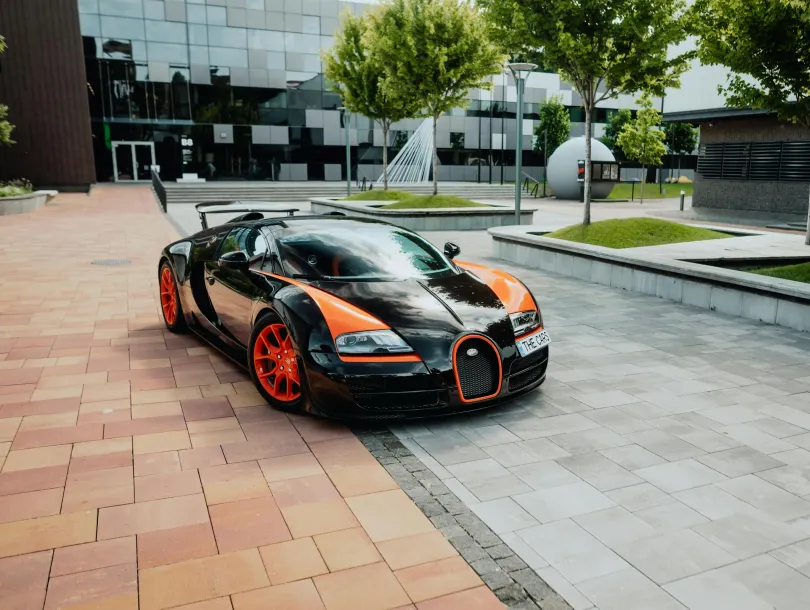
Bugatti Veyron
Bugatti introduced the Veyron 16.4 in 2005 under the direction of Ferdinand Piëch and the Volkswagen Group. Named after French racing driver Pierre Veyron, who won the 1939 24 Hours of Le Mans in a Bugatti, the vehicle was engineered to fulfill a specific technical challenge: exceed 1,000 metric horsepower and cross the 400 km/h (248 mph) speed barrier in a production car while remaining tractable on public roads.
The hypercar was built around an 8.0-liter quad-turbocharged W16 engine delivering 1,001 PS (987 hp) and 1,250 Nm of torque. Power reached all four wheels through a bespoke seven-speed dual-clutch transmission engineered by Ricardo. Managing the extreme heat generated by the powertrain at high loads required ten individual radiators divided across the engine, transmission, and auxiliary cooling circuits.
Bugatti expanded the lineup with open-top variants, including the Grand Sport and Grand Sport Vitesse, before launching the 1,200-horsepower Super Sport in 2010. The Super Sport set a world speed record for production cars at 431.072 km/h (267.856 mph). Total production across all derivatives was capped at 450 units, concluding in 2015 and establishing the engineering foundation for its successor, the Chiron.
Key specifications
Differences between variants
| Specification | Bugatti Veyron 16.4 | Bugatti Veyron Grand Sport | Bugatti Veyron Super Sport | Bugatti Veyron Grand Sport Vitesse |
|---|---|---|---|---|
| Body style | Coupe | Roadster | Coupe | Roadster |
| Power | 736.23 kW | 736.23 kW | 882.6 kW | 882.6 kW |
| Production period | 2005-2011 | 2009-2015 | 2010-2011 | 2012-2015 |
Generations and variants
Bugatti Veyron - EB 16.4
Bugatti Veyron 16.4
2005-2011- Body style
-
Coupe
- Engine
- 8 l · Quad-turbo · W16
- Power
- 736.23 kW
- Drivetrain
-
All-wheel drive
- Transmission
-
Dual-clutch· 7 speeds
Bugatti Veyron Grand Sport
2009-2015- Body style
-
Roadster
- Engine
- 8 l · Quad-turbo · W16
- Power
- 736.23 kW
- Drivetrain
-
All-wheel drive
- Transmission
-
Dual-clutch· 7 speeds
Bugatti Veyron Super Sport
2010-2011- Body style
-
Coupe
- Engine
- 8 l · Quad-turbo · W16
- Power
- 882.6 kW
- Drivetrain
-
All-wheel drive
- Transmission
-
Dual-clutch· 7 speeds
Bugatti Veyron Grand Sport Vitesse
2012-2015- Body style
-
Roadster
- Engine
- 8 l · Quad-turbo · W16
- Power
- 882.6 kW
- Drivetrain
-
All-wheel drive
- Transmission
-
Dual-clutch· 7 speeds
Facts
The Veyron uses permanent all-wheel drive to put the W16 engine’s power onto the road.
The Veyron transmits its power through a seven-speed dual-clutch gearbox.
Bugatti quoted a 0-100 km/h time of 2.5 seconds for the Veyron 16.4.
The Veyron 16.4 engine delivers 1,250 Nm of torque from 2,200 to 5,000 rpm.
The original Veyron 16.4 produced 1,001 PS, surpassing the 1,000-horsepower threshold in a series-production road car.
The Veyron 16.4 uses an 8.0-litre W16 engine with four turbochargers.
The production Veyron 16.4 had a stated top speed of 407 km/h.
Bugatti ended production of the Veyron family in 2015, after a decade of building the model in Molsheim.
Series production of the Bugatti Veyron 16.4 began in Molsheim in 2005.
To unlock speeds above 400 km/h, the Veyron required a special Speed Key that put the car into a dedicated aerodynamic configuration.