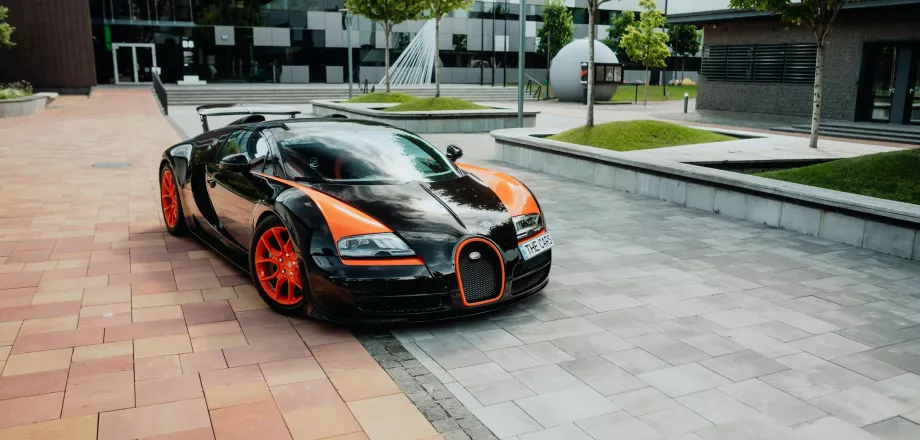
Bugatti Chiron
Bugatti introduced the Chiron at the 2016 Geneva Motor Show as the successor to the Veyron, naming the hypercar after Monegasque racing driver Louis Chiron. Hand-assembled at the company's headquarters in Molsheim, France, the vehicle was engineered around an updated carbon-fiber monocoque chassis with a structural stiffness comparable to LMP1 endurance race cars.
At launch, the Chiron featured a heavily redesigned 8.0-liter quad-turbocharged W16 engine delivering 1,500 horsepower and 1,600 Nm of torque. Power was routed through a seven-speed dual-clutch transmission to a permanent all-wheel-drive system with an electronically controlled rear differential. To manage extreme thermal loads at high speeds, the powertrain relied on a multi-radiator cooling system capable of circulating over 800 liters of coolant per minute.
Bugatti expanded the lineup with targeted derivatives, including the lighter Chiron Sport, the agility-focused Pur Sport, and the 1,600-horsepower Super Sport. In 2019, a modified prototype based on the Super Sport 300+ became the first production-derived vehicle to break the 300 mph threshold, achieving a top speed of 304.773 mph (490.484 km/h). Total production was strictly capped at 500 units, with the final example completed in 2024 as Bugatti prepared to transition to its hybrid Tourbillon platform.
Key specifications
Differences between variants
| Specification | Bugatti Chiron | Bugatti Chiron Sport | Bugatti Chiron Super Sport 300+ | Bugatti Chiron Pur Sport | Bugatti Chiron Super Sport |
|---|---|---|---|---|---|
| Power | 1103.25 kW | 1103.25 kW | 1176.8 kW | 1103.25 kW | 1176.8 kW |
| Production period | 2016-2022 | 2018-2022 | 2019-2021 | 2020-2024 | 2021-2024 |
Generations and variants
Bugatti Chiron
Bugatti Chiron
2016-2022- Body style
-
Coupe
- Engine
- 8 l · Quad-turbo · W16
- Power
- 1103.25 kW
- Drivetrain
-
All-wheel drive
- Transmission
-
Dual-clutch· 7 speeds
Bugatti Chiron Sport
2018-2022- Body style
-
Coupe
- Engine
- 8 l · Quad-turbo · W16
- Power
- 1103.25 kW
- Drivetrain
-
All-wheel drive
- Transmission
-
Dual-clutch· 7 speeds
Bugatti Chiron Super Sport 300+
2019-2021- Body style
-
Coupe
- Engine
- 8 l · Quad-turbo · W16
- Power
- 1176.8 kW
- Drivetrain
-
All-wheel drive
- Transmission
-
Dual-clutch· 7 speeds
Bugatti Chiron Pur Sport
2020-2024- Body style
-
Coupe
- Engine
- 8 l · Quad-turbo · W16
- Power
- 1103.25 kW
- Drivetrain
-
All-wheel drive
- Transmission
-
Dual-clutch· 7 speeds
Bugatti Chiron Super Sport
2021-2024- Body style
-
Coupe
- Engine
- 8 l · Quad-turbo · W16
- Power
- 1176.8 kW
- Drivetrain
-
All-wheel drive
- Transmission
-
Dual-clutch· 7 speeds
Facts
The Chiron’s extensive cooling system uses a total of 10 radiators.
The Chiron sends its power through a permanent all-wheel-drive system.
In road specification, the Chiron’s top speed was electronically limited to 420 km/h.
Bugatti quoted a 0-100 km/h time of 2.4 seconds for the Chiron.
The Chiron engine delivers 1,600 Nm of torque from 2,000 to 6,000 rpm.
The standard Chiron produces 1,500 PS.
The Chiron uses an 8.0-litre W16 engine boosted by four turbochargers.
In 2024 Bugatti completed the Chiron series by assembling the 500th and final car in Molsheim.
Bugatti planned from the outset to produce 500 cars in the Chiron series.
The Bugatti Chiron made its world premiere in 2016 as the successor to the Veyron.
Continue exploring
Bugatti EB110
Bugatti Veyron