The Audi R8 was the brand's first series-production supercar with a mid-mounted engine. Unveiled in 2006 and on sale from 2007, it spent seventeen years combining technology associated with racing cars with high build quality and an unusual degree of everyday usability. It was offered as a closed Coupé and an open Spyder, initially with a naturally aspirated V8 and later predominantly with a V10. The final car was built on 22 March 2024. Across two generations, Audi produced 45,949 examples.
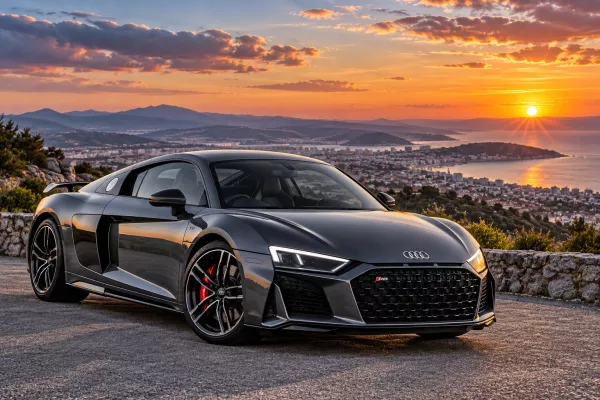
The R8's history also tells the story of Audi's changing position in the automotive world. A manufacturer known chiefly for quattro all-wheel drive, fast saloons and successes in rallying and endurance racing decided to enter a market traditionally occupied by Ferrari, Lamborghini and the most expensive Porsches. Yet the R8 did not set out to imitate any of them exactly. Its character emerged from the engine behind the occupants, aluminium construction, abundant traction and a carefully considered cockpit.
This article covers the road-going Audi R8 family, including the first-generation Type 42 and the second-generation Type 4S. The Le Mans quattro concept, the experimental R8 V12 TDI, the electric R8 e-tron and the R8 LMS racing cars are treated separately. Their construction, purpose and results should not be confused with the specifications of the conventional production road cars.
From the racing R8 to the idea of a road car
Audi used the R8 name before its road-going supercar appeared. It belonged to the sports prototype that competed in endurance racing and won the 24 Hours of Le Mans five times, in 2000, 2001, 2002, 2004 and 2005. Those victories established the marque's credibility in high-performance engineering. They did not, however, make the road-going R8 a straightforward conversion of the racing prototype. The two shared above all a name, ambitions and a broader brand-building purpose.
During the early 2000s, Audi was extending its presence in the luxury and performance markets. Its RS models and the TT had established a recognisable identity, but even their most powerful variants remained closely related to higher-volume cars. A supercar with its engine behind the passenger compartment presented different opportunities for weight distribution, styling proportions and the application of expertise developed by quattro GmbH, subsequently renamed Audi Sport GmbH.
Audi's position within the Volkswagen Group helped make the project possible. Lamborghini, owned by the group through Audi since 1998, provided an important technical foundation. The first R8 was related to the Gallardo, while the second was related to the Huracán. That does not mean the R8 was merely a rebadged Lamborghini. The cars differed in suspension tuning, appearance, interior execution, controls and market positioning. Audi wanted a supercar whose owner would not have to treat it solely as a machine for occasional weekend drives.
The 2003 Le Mans quattro: a preview of the R8
At the 2003 Frankfurt Motor Show, Audi presented the Le Mans quattro concept. It featured a low roof, a broad body, prominent side air intakes and an engine mounted longitudinally behind the occupants. Its proportions immediately made clear that this was a very different proposition from a sporting A4 or TT.
The concept's exterior was designed by Frank Lamberty, who also worked on the first production R8. The project took shape within Audi's design organisation, led at the time by Walter de Silva. Those roles should be distinguished: directing an entire design department is not the same as personally developing the surfaces of an individual car.
The Le Mans quattro used a twin-turbocharged 5.0-litre V10 with direct fuel injection. Audi quoted 610 metric horsepower (PS) and 750 Nm. It was primarily a demonstration of technical possibilities, rather than a production-ready engine destined for the showroom model. The concept also featured an aluminium load-bearing structure, advanced lighting and adaptive dampers. Audi's contemporary material emphasised the combination of performance, comfort and easy manoeuvrability.
That last objective would help define the production R8. It had to give the driver some of the sensation of a racing machine while providing reasonable visibility, intuitively arranged instruments and civilised behaviour on ordinary roads. Once Audi's management approved series production, it became clear that the concept would not remain a one-off styling exercise.
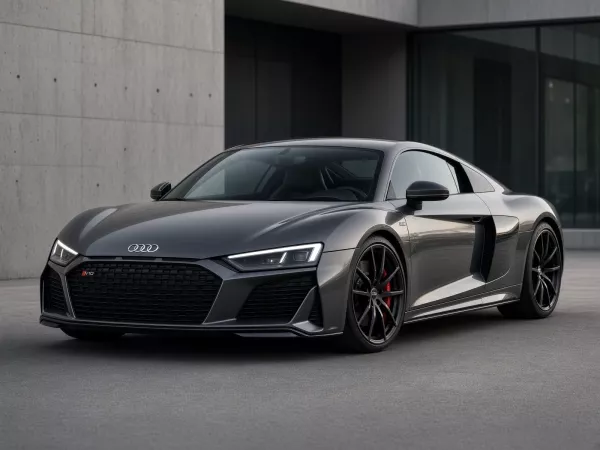
First generation, Type 42: the 2006 debut
The production Audi R8 debuted at the Paris Motor Show in September 2006, with sales beginning in 2007. It retained the main proportions of the Le Mans quattro: a short bonnet, a forward-set cabin, broad rear wings and a glazed cover through which the engine could be seen on the Coupé.
Its most distinctive styling feature was the sideblade, a large panel behind each door running alongside the lateral air intake. Often finished in a contrasting colour, it visually separated the cabin from the engine bay and emphasised the unusual proportions. It was not simply decoration: the adjacent side air passages helped cool the powertrain.
The body was based on Audi Space Frame architecture, a light supporting structure made mainly of aluminium. Combining castings, extrusions and sheet-metal sections delivered the required rigidity at a sensible weight. The body was not a conventional steel monocoque, and the design of its components reflected the requirements of relatively low-volume manufacturing.
The first R8 could be specified with a six-speed manual gearbox or the optional R tronic automated transmission. The manual's exposed metal shift gate quickly became one of the car's signature details. In the automated unit, actuators operated the gear selection and a single clutch, producing a more noticeable interruption in torque delivery during shifts than the dual-clutch systems introduced later.
The original R8 was not particularly small, but its proportions served its dynamic purpose. The mid-engine layout placed more weight over the rear axle, while its broad track and low centre of gravity helped during rapid changes of direction. Relatively accommodating suspension calibration allowed Audi to avoid the extreme nervousness sometimes associated with uncompromising track-focused cars.
The 4.2 FSI V8: the original R8's foundation
The initial R8 used a naturally aspirated V8 displacing 4,163 cc, with direct petrol injection. In its original European specification it produced 420 PS and 430 Nm. The unit was closely related to the engine in the B7-generation Audi RS 4, though its installation was adapted to the R8's mid-engine location and specific operating demands.
A significant difference was dry-sump lubrication. Rather than relying exclusively on oil collecting beneath the crankshaft, this system uses a separate reservoir and pumps to maintain oil circulation during high lateral loads. It also permits the engine to be positioned lower. Both the centre of gravity and oil supply during sustained fast cornering benefited.
Without forced induction, the V8's performance built as revs increased. The car encouraged the driver to use the upper part of the rev counter, and throttle response was immediate. Audi quoted roughly 4.6 seconds from 0 to 100 km/h and a top speed approaching 300 km/h for the early R8 V8. These were not outright class records, but the combination of speed, sound and predictable handling gave the model considerable appeal.
The output of certain later V8 versions rose to 430 PS. Comparisons between first-generation cars must therefore account for model year, market and engine variant. The designation 'R8 4.2' alone does not capture every detail of the specification.
The V10: the engine that changed the model's standing
In 2008, Audi introduced the R8 5.2 FSI quattro, which reached customers the following year. The naturally aspirated 5,204 cc V10 produced 525 PS in its initial European form. It belonged to the same engine family as the Lamborghini Gallardo's unit, although Audi tailored the configuration to its own car.
Two extra cylinders transformed the R8 more than the increase in published performance figures might suggest. The V10 supplied more torque, stronger acceleration at high road speeds and a distinctive metallic note that intensified with the revs. The car could now challenge Ferrari and Lamborghini more directly while retaining its calmer disposition in everyday traffic.
Equally important was what Audi's engineers chose not to do. As turbocharging spread through the high-performance market, the R8 remained committed to naturally aspirated engines. That was not an advantage in every situation: turbocharged rivals could deliver more torque at low engine speeds. The V10 countered with linear response and particularly precise control over the available power.
The first-generation model also retained a relatively broad range. Buyers could choose a V8 or V10, a closed roof or a Spyder, and for some time a manual transmission as well. These combinations helped shape the R8's personality and still affect the interest shown in individual variants.
Quattro, suspension and brakes: substance behind the technology
The name quattro was deeply connected with Audi's rallying history, but the first R8's drivetrain differed fundamentally from the layouts found in its front-engined saloons. With the engine mounted centrally, the rear axle played the principal role, while the front wheels received some torque through a viscous coupling. The system improved traction when exiting corners and on surfaces with variable grip, without obscuring the car's predominantly rear-driven character.
Double wishbones were used at both ends. This arrangement gives engineers considerable control over wheel alignment during suspension travel and body roll. Audi also offered magnetic ride, using dampers filled with fluid containing tiny magnetic particles. By varying the magnetic field, the electronics altered damping force without relying on a conventional valve with only a few fixed settings.
In practice, the driver could enjoy reasonable comfort on public roads and then select settings that better restrained body movement during spirited driving. That did not turn the R8 into a soft grand tourer: broad tyres, limited ground clearance and a low seating position remained part of the experience.
The brakes evolved with the model range. Higher-performance variants could be fitted with carbon-ceramic discs, which offer thermal resistance and lower weight than typical cast-iron discs. Their advantages during sustained circuit use were clear, but replacement costs could be substantial and remain an important ownership consideration.
The Spyder, R8 GT and the first-generation update
The open-top R8 Spyder debuted in 2009 and reached customers in 2010. At first the principal version was the Spyder 5.2 FSI V10; a V8 joined the range later. Its fabric roof and structural reinforcements affected weight and body rigidity, but also let occupants hear the engine almost directly behind them. The rear styling was reworked for the convertible: the Coupé's large contrasting sideblade gave way to a different arrangement of side panels.
In 2010, Audi presented the R8 GT Coupé, a lighter and more powerful V10 version producing 560 PS. Audi claimed a weight reduction of about 100 kg compared with a corresponding standard version. The car received aerodynamic changes and elements aimed more firmly at circuit driving. Production of the Coupé was limited to 333 examples. A similarly conceived R8 GT Spyder followed in 2011, also restricted to 333 cars.
The GT name should not be confused with the R8 LMS racing programme. The GT remained a road-legal production derivative, while the LMS was developed around motorsport regulations with very different equipment and several fundamental engineering differences.
Audi refreshed the first generation in 2012. The bumpers and lighting were revised, but the most consequential change concerned the transmission. The six-speed R tronic was replaced by the seven-speed dual-clutch S tronic. Its two clutches and ability to preselect the next ratio shortened torque interruptions and made driving smoother. The updated range also gained the 550 PS R8 V10 plus.
The first generation culminated in the limited R8 LMX of 2014. Its V10 produced 570 PS, and production was restricted to 99 examples. Laser high-beam technology distinguished the model and allowed Audi to demonstrate a new approach to vehicle lighting. This was equipment on a particular high-performance special edition, not a feature fitted as standard to every R8 of the period.
Why the first R8 drove differently from a Lamborghini
The close engineering relationship between the R8 and Gallardo invited comparisons, but they were about far more than establishing which was faster. Lamborghini emphasised a more uncompromising character; Audi prioritised control and ergonomics. Contemporary tests of the first R8 frequently praised its steering precision, stability and refinement at ordinary road speeds.
The reviews were not uniformly enthusiastic. Testers noted that the manual gearbox, for all the appeal of its exposed metal gate, demanded accurate movements, while the R tronic could deliver abrupt shifts. The steering and suspension offered reassuring responses, although some journalists comparing the R8 with cars such as the Porsche 911 GT3 or Ferrari F430 wanted more detailed feedback from the front wheels.
Measurements by Car and Driver illustrate the distinction between manufacturer specifications and independent results. In a 2007 comparison, the original R8 V8 recorded approximately 4.3 seconds from rest to 60 mph, or roughly 97 km/h. This is not a 0-100 km/h result and must not be represented as such. Audi, meanwhile, quoted around 4.6 seconds to 100 km/h for the appropriate European version. Both numbers can be valid because the speed thresholds, test procedures and conditions differ.
Second generation, Type 4S: unveiled in 2015
Audi revealed the second-generation R8, designated Type 4S, at the Geneva Motor Show in March 2015. The underlying concept remained unchanged: a two-seat cabin, a mid-mounted engine, a broad body and a carefully finished interior. The details were different, however, with sharper body lines, revised lighting and a more angular visual treatment.
Technically, the car was closely related to the Lamborghini Huracán. It used a new body structure, an updated V10 and the seven-speed S tronic transmission. The most important change to the engine range was the discontinuation of the V8. At launch, the V10 and V10 plus produced 540 and 610 PS respectively, with both versions driving all four wheels. A manual gearbox never returned to the R8 catalogue.
According to Audi, the R8 V10 plus accelerated from 0 to 100 km/h in 3.2 seconds and could reach 330 km/h. Greater power allowed it to compete with the most demanding versions of contemporary supercars. Offering a standard V10 alongside the plus also let customers choose their preferred balance: not every buyer needed the firmest chassis setup, carbon-ceramic brakes and maximum output.
The new R8 was assembled at Audi's Böllinger Höfe facility in Heilbronn, associated with the Neckarsulm production complex. Manual work continued to play a considerable part in body construction and final assembly, despite the application of modern quality-control systems. It is an important distinction: the R8 was a genuine factory-built series-production model with the resources of a large manufacturer behind it, but its production scale and assembly process were quite unlike those of a high-volume Audi saloon.
A new Audi Space Frame: aluminium and composites
The second-generation ASF adopted a multi-material construction. Aluminium extrusions, castings and panels were combined with components made from carbon-fibre-reinforced plastic. In Audi's technical material on the updated R8, the Coupé's supporting structure weighed approximately 200 kg, with composites accounting for around 14 per cent of that mass and aluminium around 79 per cent.
Composite parts were employed where they could efficiently stiffen the passenger cell, including the central tunnel and selected areas of the rear bulkhead. This does not mean the entire body was built from carbon fibre. Aluminium remained the dominant material, with individual components designed around structural loads, crash-energy management and repair requirements.
A rigid structure helps the suspension maintain its intended geometry under load. It also matters for the Spyder's handling, where the lack of a fixed roof requires additional reinforcement of the sills and windscreen frame. In an open car, some of the potential weight benefit necessarily gives way to stiffness and safety requirements.
Published weights for different R8 versions need careful handling. Manufacturers, magazines and approval documents may use different definitions, including dry weight, kerb weight or a mass that includes a driver. Conflicting figures do not necessarily mean that one version genuinely weighed the stated number of kilograms less than another.
The second-generation V10 and seven-speed S tronic
The 5.2 FSI retained its naturally aspirated design, while its ancillary systems and management continued to evolve. In the second generation, Audi employed a combination of direct and indirect fuel injection, allowing the mixture-formation process to be adapted to engine load and speed. The company also used efficiency measures for low-load operation, including the temporary deactivation of some cylinders under appropriate conditions.
High-revving performance remained the V10's defining trait. Power delivery was linear, and the wide usable rev range gave the driver precise control. The demands placed on cooling and lubrication were nonetheless considerable. A car capable of these speeds needs extensive coolant circuits, carefully managed airflow and protection against the loads generated by sustained track use.
The dual-clutch S tronic offered fully automatic operation or manual gear selection through steering-wheel paddles. Compared with the earlier R tronic, it was smoother in ordinary driving and more effective during rapid downshifts. Something distinctive had nevertheless disappeared: the mechanical connection between the driver's hand and the gearbox through a conventional gear lever.
The second-generation car also received a new implementation of quattro, using an electronically controlled clutch to send torque to the front axle. It could react more rapidly to changing grip and cooperate with the stability-control system. Even so, all-wheel drive cannot create unlimited traction: the tyres, road surface and loads on the wheels ultimately determine what the car can do.
Interior: a sports-car cockpit without unnecessary austerity
The first R8 had a dashboard recognisably related to other Audis of its era, with conventional instruments and a centre console that anyone moving from a regular model could understand. The seats provided appropriate support, while the quality of plastics, leather and metal trim was a major selling point in a segment where rivals often made a more overt display of their racing-derived technology.
The second R8 introduced the Audi virtual cockpit, a 12.3-inch digital instrument display that replaced conventional gauges. The driver could select layouts dominated by the rev counter, navigation or supplementary driving information. Moving some controls onto the steering wheel and dispensing with a large central dashboard screen reduced the need to look away from the road.
Comfort did not mean spaciousness. The R8 had two seats, very limited baggage accommodation and rearward visibility typical of a mid-engined car. For late versions of the second generation, Audi quoted 112 litres of front luggage capacity and a further 226 litres behind the seats. The figures convey the engineers' intentions: make travel for two practical enough, without pretending to offer the load space of a large grand tourer.
The second-generation Spyder and the arrival of the R8 RWS
The new R8 Spyder was revealed in 2016. It retained a folding fabric roof but had a body structure and styling adapted to the new generation. The open configuration made the sound of the V10 particularly prominent. In return for open-air driving, owners accepted structural reinforcements and greater weight than in a corresponding Coupé.
A more fundamental change arrived in 2017 with the R8 V10 RWS. The initials stood for Rear Wheel Series, marking a version driven by the rear axle alone. Initially, combined Coupé and Spyder production was limited to 999 examples. The engine produced 540 PS, and eliminating the hardware driving the front wheels reduced weight.
The RWS was not simply a cheaper R8 with quattro components removed. The way the rear tyres generated and managed traction changed, along with the car's response when power was applied through a corner. The driver could feel a stronger influence from engine torque on the car's balance, although the electronic stability systems still supervised its behaviour. Later R8 RWD variants turned this initially limited idea into a regular part of the range.
The decision carried symbolic weight. Audi had built much of its reputation around quattro, yet allowed its most sporting model to adopt rear-wheel drive when that configuration better met some customers' expectations. By then, the R8 was more than a showcase for any single proprietary technology.
The 2018 update and the final derivatives
At the end of 2018, Audi revealed the revised R8 for a 2019 market introduction. Its body acquired more assertively shaped intakes, redesigned bumpers and aerodynamic changes. The update also brought revisions to the suspension and steering.
Quattro-equipped versions were sold as the 570 PS R8 V10 quattro and 620 PS R8 V10 performance quattro. Rear-wheel-drive versions developed in parallel. In 2021, Audi introduced the R8 V10 performance RWD with 570 PS. The distinctions between model names are important: 'performance' did not always mean the same drivetrain or output across different model years.
Audi had also celebrated ten years of the road-going V10 with the R8 V10 Decennium, limited to 222 cars. Its main distinctions were its trim and commemorative character, not the creation of a new technical generation. Special editions such as this broadened the catalogue while leaving the vehicle's fundamental architecture unchanged.
In October 2022 came the R8 Coupé V10 GT RWD, developed for the model's final production period. It offered 620 PS, a seven-speed dual-clutch transmission with revised characteristics and an additional aerodynamic package. A special Torque Rear system allowed the driver to select different levels of permitted oversteer through the stability electronics. Production was limited to 333 numbered cars, with customer availability from 2023.
The GT neatly encapsulated the distance travelled since the R8's introduction. The first car was associated with a V8, a manual gearbox and quattro. The final GT combined a 620 PS V10 with rear-wheel drive, sophisticated electronics and a clearer focus on circuit driving.
Manufacturer figures and independent performance tests
The second R8 delivered results comparable with established supercars of its day. Audi claimed 3.2 seconds to 100 km/h for the early V10 plus. After the update, the performance quattro version offered 620 PS while retaining the high-speed performance of a naturally aspirated engine.
Independent testing explains why an assessment of the R8 should not stop with catalogue specifications. In a test of a US-market R8 V10 plus published in 2016, Car and Driver measured 2.9 seconds from 0 to 60 mph, equivalent to approximately 97 km/h. The same car completed the standing-start quarter-mile in 10.9 seconds. The first figure should not be compared directly with a European 0-100 km/h time, because the endpoint is different.
Comparative tests also exposed the limitations of Audi's chosen philosophy. The R8 could be more comfortable on uneven roads than more radical competitors, but in some tests generated slightly less lateral grip or conveyed less information at the edge of adhesion. That did not point to an inherently deficient chassis. Springs, dampers, tyres and steering calibration reflected a deliberate compromise between speed and comfort.
Specification also had a substantial effect on individual results. US and European cars did not always share exactly the same dampers, wheels or equipment. Comparing the weight of a tested car with a catalogue figure therefore requires attention to the weight definition, market and optional equipment.
The R8 e-tron: an electric experiment alongside the petrol V10
Audi developed the electric R8 e-tron alongside the combustion-engined model. Its early concepts and prototypes from around the turn of the 2010s differed in specification from the later car. They should not be treated as one unchanging technical configuration.
When the second-generation R8 appeared in 2015, Audi also showed a more developed R8 e-tron, equipped with two electric motors producing a combined 340 kW, or approximately 462 PS, and a stated maximum torque of 920 Nm. Audi quoted 0-100 km/h in 3.9 seconds and a range of more than 450 km under the testing assumptions of the period. Those figures relate to that particular version and its contemporary test framework; they are neither a modern WLTP result nor an independent real-world measurement.
Unlike the earlier prototypes, this version was offered to customers, but sales remained extremely limited. In a later historical account, Audi stated that fewer than 100 examples had been sold. The R8 e-tron was therefore primarily a technological and brand-building exercise, not an electric equivalent of the mass-produced V10 in terms of production volume.
The programme anticipated a broader direction of travel for the automotive industry, but it did not lead directly to an immediate wholesale conversion of the R8 range to battery power. Audi Sport's main road-car offering remained a high-revving petrol machine, while the brand was also developing electric powertrains in other programmes.
The R8 V12 TDI: a concept that never reached showrooms
An even more unusual chapter was the R8 V12 TDI concept, displayed in 2008. Audi used the success of its diesel-powered endurance-racing prototypes to examine the possibility of building a road-going supercar around a compression-ignition engine.
The concept used a twin-turbocharged V12 displacing approximately six litres. Audi quoted around 500 PS and fully 1,000 Nm. Such high torque at low revs created an entirely different power-delivery profile from those of the naturally aspirated V8 and V10. It also imposed different requirements on cooling, transmission design and weight distribution.
The R8 V12 TDI never entered series production. Its figures should not be added to the performance specifications of showroom R8s, still less presented as those of an exceptionally rare production variant. The concept remains evidence of a period when Audi's diesel victories at Le Mans encouraged engineers to consider the technology even for unconventional applications.
Audi R8 LMS: a different car with genuine racing achievements
From 2009, Audi Sport customer racing developed the R8 LMS for competition. Similar looks and a shared name did not make it identical to the road car. The R8 LMS GT3 was created under GT3 regulations, with a roll cage, aerodynamic features developed for racing, competition suspension and rear-wheel drive rather than the road model's quattro system.
The layout reflected sporting rules and the realities of endurance competition. The racing car had to be quick, serviceable, durable and manageable enough for customer teams. Audi developed successive versions based on both generations of the road-going R8, updating aerodynamic details and maintenance-related features.
Its major results included victories in the Nürburgring 24 Hours as well as successes at Spa and Bathurst. In its 2024 review, Audi credited the R8 LMS GT3 with seven overall wins in the Nürburgring 24 Hours and eleven further victories in international 24-hour races. These were achievements of purpose-built racing cars, not road-homologated production R8s.
The programme later expanded into other categories. The R8 LMS GT4 was conceived as a more accessible customer racing car, while the R8 LMS GT2 adopted a different technical specification and a particularly powerful engine. Historical comparisons must distinguish these classes because their regulations constrain power, aerodynamics and other aspects of construction differently.
Audi stated in 2024 that 454 racing R8s had been produced since the beginning of the customer racing programme, including 313 GT3 versions. These are racing-programme figures and should not be added without explanation to the 45,949 production road cars.
Production and the R8's market position
The first R8 was built in Neckarsulm, while the second generation used the Böllinger Höfe facility in nearby Heilbronn. Production remained relatively low-volume. Specialised workers carried out assembly operations, and individual cars underwent quality checks and verification drives before delivery.
Audi reported that production of the first generation exceeded 26,000 cars, and that the total for both generations reached 45,949. These numbers are modest beside Audi's regular models, but they also show that the R8 was neither a short-lived experiment nor a symbolic run of a few hundred cars.
Its pricing was ambitious from the outset. The first R8 appealed to buyers also considering the Porsche 911 Turbo and more exotic mid-engined alternatives. At the launch of the second generation in Germany in 2015, the official list prices began at €165,000 for the V10 and €187,400 for the V10 plus. These are contemporary German-market list prices, not current used-car valuations.
The R8's value to Audi's image exceeded its production volume. It demonstrated that the marque's engineering and design culture could operate in territory occupied by Ferrari and Lamborghini. At the same time, the car could benefit from shared Volkswagen Group components without abandoning Audi's own styling language or approach to controls and refinement.
Ownership: strengths and expensive compromises
An assessment of a used R8 must distinguish inherent dependability from the expense of maintaining a supercar. Engines, brakes, transmissions and suspension components operate under more demanding conditions than in an ordinary passenger car, while specialist labour and replacement parts are priced accordingly.
On the first generation, the choice of gearbox deserves particular attention. A conventional manual requires checks of clutch condition and shift quality; the automated R tronic has a different operating character and potential servicing costs; and the later S tronic is more mechanically complex, even if it is much better suited to everyday driving. A fair assessment of any particular car requires service records and a thorough inspection rather than assuming that every R8 suffers the same problems.
Magnetic ride suspension and carbon-ceramic brakes can also add substantially to repair costs when components require replacement. Tyre condition directly affects handling, especially in rear-wheel-drive cars. Examples that have regularly been used on track warrant careful checks of brakes, suspension, cooling and any repairs to the body.
The ASF structure makes the quality of accident repairs especially important. Restoring aluminium load-bearing components and their joints with composite elements demands the correct procedures. Techniques accepted for an ordinary steel bodyshell are not necessarily appropriate for an R8. For prospective buyers, a documented vehicle history is consequently more valuable than the apparently attractive price of a car with an uncertain past.
Recall and service-campaign histories vary with model year, market and vehicle identification number. Rather than extending a handful of online reports to the entire R8 family, owners should use the relevant manufacturer's and regulator's databases to check which campaigns applied to a specific car and whether the work was completed.
The R8 in popular culture
The R8 soon became recognisable well beyond motoring enthusiasts. Its appearances in Marvel films were particularly influential, with the first generation closely associated with Tony Stark. Other versions appeared in subsequent films, including the electric R8 e-tron.
In this context, the earlier film car known as the Audi RSQ should be distinguished from the production R8. The futuristic RSQ was created for the 2004 film I, Robot. Its proportions anticipated some design themes seen in later sporting Audis, but it was neither a homologation prototype nor a road-going R8 derivative.
Film exposure helped the R8's public profile, but its lasting position rests on more than screen appearances. It established a niche in the supercar market by combining naturally aspirated engines, a mid-engine layout, interior quality and relatively approachable on-road behaviour.
The end of production in March 2024
The final production R8 left the line at Böllinger Höfe on 22 March 2024. Finished in Vegas Yellow, it was destined for Audi's collection in Ingolstadt. The car closed seventeen years of production that had begun with a much less powerful V8.
Discontinuation also meant the departure of this application of Audi's naturally aspirated V10 from the model range. It reflected wider changes in the industry: stricter emissions requirements, the growing importance of electrification and shifting investment priorities among car manufacturers. Ending R8 production did not, however, mean Audi had already launched a direct successor with precisely the same role. When the programme ended, the second-generation R8 had not been replaced by a new model carrying the name.
The legacy of two generations
The first Audi R8 proved that a manufacturer known for sophisticated road cars could enter the supercar market without copying Ferrari or Lamborghini. Its V8, manual gearbox and aluminium body gave it a distinctive identity. The V10 expanded its performance envelope and brought it closer to the fastest rivals.
The second generation developed that idea rather than attempting to reinvent it. It offered a stiffer multi-material structure, more powerful V10, faster transmission and new electronic systems. Eventually, rear-wheel-drive versions also appeared, challenging the apparently inseparable connection between this supercar and quattro. Meanwhile, the R8 LMS programme supplied independent evidence of Audi Sport's capabilities in GT racing.
Seen in the context of automotive history, the R8 is fascinating precisely because of the compromises its engineers chose. It was not always the most radical track car or the lightest in its class. It could nevertheless combine supercar performance with ergonomics and predictability that encouraged owners to use it more often. When production ended in 2024, the market lost more than one of the last naturally aspirated V10s in this part of the segment. It lost a particular interpretation of the exotic car: extraordinarily fast and technically sophisticated, yet usable without making every journey an occasion.