Aston Martin DBX
Aston Martin introduced the DBX in 2019 as its first production SUV, designed to expand the brand's global reach and enter the luxury crossover segment. Built at a dedicated manufacturing plant in St Athan, Wales, the vehicle was developed on an all-new bonded aluminum platform rather than adapting an existing shared chassis.
Under the hood, the original DBX featured a Mercedes-AMG 4.0-liter twin-turbo V8 generating 550 horsepower and 700 Nm of torque. Power was delivered to all four wheels through a nine-speed automatic transmission, an active central differential, and an electronic rear limited-slip differential. To balance ride comfort with body control, Aston Martin equipped the model with adaptive triple-chamber air suspension and a 48-volt active anti-roll system. The DBX quickly became the company's core sales driver and established the platform for the higher-performance DBX707.
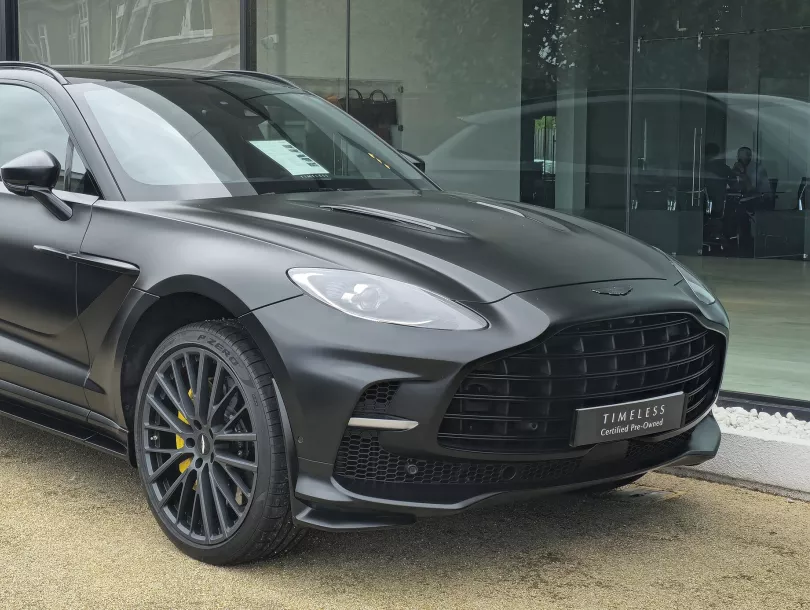
Key specifications
Differences between variants
| Specification | Aston Martin DBX | Aston Martin DBX707 | Aston Martin DBX S |
|---|---|---|---|
| Power | 404.52 kW | 520 kW | 534.71 kW |
| Production period | 2020-2024 | 2022- | 2025- |
Generations and variants
Aston Martin DBX I
Aston Martin DBX
2020-2024- Body style
-
SUV
- Engine
- 4 l · Twin-turbo · V8
- Power
- 404.52 kW
- Drivetrain
-
All-wheel drive
- Transmission
-
Automatic· 9 speeds
Aston Martin DBX707
2022-- Body style
-
SUV
- Engine
- 4 l · Twin-turbo · V8
- Power
- 520 kW
- Drivetrain
-
All-wheel drive
- Transmission
-
Automatic· 9 speeds
Aston Martin DBX S
2025-- Body style
-
SUV
- Engine
- 4 l · Twin-turbo · V8
- Power
- 534.71 kW
- Drivetrain
-
All-wheel drive
- Transmission
-
Automatic· 9 speeds
Facts
The DBX707 uses a shorter 3.27 final-drive ratio instead of the standard DBX’s 3.07 ratio, sharpening powertrain response.
Aston Martin says the carbon-ceramic brakes reduce unsprung mass by 40.5 kg.
The DBX707’s standard braking system uses 420 mm front and 390 mm rear carbon-ceramic discs.
The DBX707 replaced the conventional torque converter with a wet-clutch nine-speed transmission for faster shifts.
The DBX707 uses ball-bearing turbochargers and revised engine calibration to increase output and throttle response.
The DBX707 produces 707 PS and 900 Nm from its 4.0-litre twin-turbo V8, 157 PS and 200 Nm more than the original DBX V8.
The DBX offers four on-road modes and two off-road settings that alter the powertrain and chassis behaviour.
The DBX all-wheel-drive system uses an active centre transfer case together with an electronically controlled rear differential.
The original DBX’s 4.0-litre twin-turbo V8 produced 550 PS and 700 Nm.
The 48 V electric active anti-roll system can generate up to 1,400 Nm of anti-roll torque at each axle.
More facts about Aston Martin DBX
Showing 1-10 of 20 facts