The Alfa Romeo 4C was an attempt to build a modern sports car around principles that were becoming increasingly rare in the 21st century. Instead of a large engine, extensive electronic systems and comfort-oriented equipment, it used a mid-mounted turbocharged four-cylinder engine, rear-wheel drive, a carbon-fibre monocoque and unassisted steering. The production Coupé was unveiled in 2013. Two years later came the Spider, with its removable soft top.
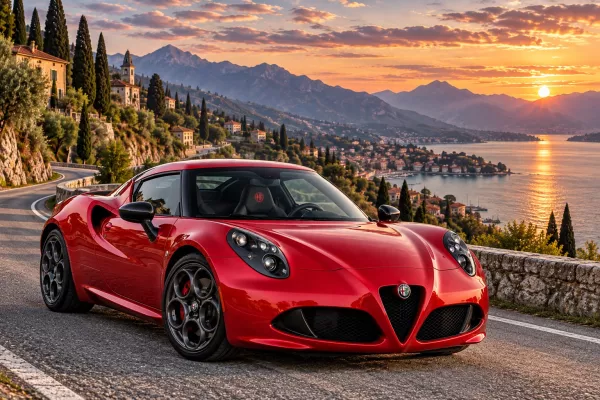
The 4C was neither a miniature Ferrari nor a conventional Alfa Romeo with extra performance. It was a purpose-built sports car defined by low weight, compact dimensions and an unusually direct connection between driver and machine. That approach produced remarkable acceleration from a 240 PS engine, but also brought a firm ride, considerable noise, limited practicality and unusually demanding steering behaviour. The tension between an ambitious engineering concept and the compromises of everyday use is central to understanding the 4C.
Why Alfa Romeo needed the 4C
Around the turn of the 2010s, Alfa Romeo faced a difficult challenge in terms of its identity. Its range included the MiTo and Giulietta, while the 159 and Brera had been important earlier models. What the brand lacked was a small, uncompromising sports car capable of recalling its historical engineering ambitions. Most of its contemporary road cars were front-wheel drive and relied on components developed within a much larger industrial group.
The Alfa Romeo 8C Competizione entered production in 2007, followed by the 8C Spider. Both were expensive, limited-production image-building models, powered by V8 engines and using technology associated with Maserati. They proved that Alfa could produce an exclusive and striking sports car, but their prices and small production runs placed them beyond the reach of most enthusiasts.
The 4C addressed a different problem: could some of the experience of an exotic mid-engined sports car be offered in a substantially smaller and less expensive vehicle? Its engineers concentrated on reducing weight, since a lighter car can accelerate, brake and change direction more effectively without requiring an exceptionally powerful engine. That philosophy also made it possible to use a four-cylinder unit developed within the Fiat group.
The project had an international role as well. Alfa Romeo was preparing to return to North America after a long absence from regular new-car sales. With its carbon-fibre structure and distinctive mid-engined proportions, the 4C made a more compelling introduction to the brand than a conventional model would have done. Initial expectations for the American launch proved optimistic, however. The US-market car was officially introduced in New York in April 2014, with sales following later that year.
From the 2011 concept to the production car
The first Alfa Romeo 4C appeared as a concept at the Geneva Motor Show in March 2011. Its defining proportions were already established: a forward-set passenger compartment, short overhangs, a broad rear section, substantial side air intakes and a transverse engine positioned ahead of the rear axle. The prototype was about four metres long, with a wheelbase of less than 2.4 metres. It was clearly intended as a compact driver's car rather than a comfortable grand tourer.
Centro Stile Alfa Romeo was responsible for the styling. The body was developed under the group's design leadership, with Alessandro Maccolini playing an especially important role in shaping the 4C's appearance. In later accounts, Maccolini identified the 1967 Alfa Romeo 33 Stradale as a direct visual reference. He also discussed the historical Scarabeo prototype as an interesting precedent for a small car with a transverse rear-mounted engine. Neither reference means that the 4C was a mechanical reproduction of those earlier designs.
The connection to the 33 Stradale mattered for the brand's design language. The low roof, pronounced rear wings and tightly packaged body evoked an era when Italian sports cars could combine compact dimensions with exceptional performance. At the same time, the 4C developed styling themes seen on the 8C Competizione, particularly in the treatment of its body surfaces and the characteristic Alfa Romeo scudetto at the front.
Alfa announced the production version in February 2013 and unveiled it at Geneva in March. The essential concept survived the transition from show car to road car. The two-seat Coupé retained its transverse mid-mounted engine, rear-wheel drive and carbon-fibre passenger cell. Production began in 2013 at the Maserati plant in Modena, with the first European deliveries planned for the autumn.
The name 4C deliberately revived Alfa Romeo's historical naming conventions. The designations 6C and 8C had once identified cars with six- and eight-cylinder engines. In this case, 4C referred to four cylinders while invoking the older relationship between light construction, performance and sporting engineering.
The lightweight philosophy: carbon fibre instead of a conventional bodyshell
The most unusual feature of the 4C was not its engine but its load-bearing structure. Most cars in its price range used a steel or aluminium unibody. Alfa instead chose a carbon-fibre-reinforced composite monocoque: a rigid central passenger cell to which the remaining structural components were attached.
According to the manufacturer, the carbon monocoque itself weighed approximately 65 kg. That figure describes the central load-bearing cell, not the complete body, chassis or vehicle. Aluminium structures were attached at the front and rear, while aluminium was also used for selected reinforcements and drivetrain mounting components. Combining these materials helped provide stiffness with low mass and allowed certain assemblies to be designed as separate modules. It also made production, and potentially accident repair, considerably more complicated.
The monocoque was manufactured from prepreg material, meaning carbon fibres pre-impregnated with a controlled quantity of resin. Layers were arranged to address the anticipated loads and then cured under carefully controlled conditions. Specialist Italian suppliers associated with the Adler group were involved in manufacturing the passenger cells. For a relatively low-volume car, the process offered significant engineering freedom, though with different production costs and quality-control requirements from those of a conventional pressed-steel body.
Carbon fibre did not cover every part of the car. Much of the exterior bodywork used lightweight sheet-moulding compound, or SMC, a composite formed from resin and reinforcement. Alfa said these panels reduced weight compared with conventional steel panels while allowing complex shapes to be produced. Polyurethane was used for certain other exterior components, and even the glazing was selected with weight reduction in mind.
This division of functions is important. The carbon cell carries the principal structural loads, while the outer panels create the car's appearance and perform practical and aerodynamic tasks. Damage to a painted outer panel is therefore not equivalent to damage to the monocoque. That distinction makes accident history and repair quality particularly important when examining a used 4C.
How much does the Alfa Romeo 4C really weigh?
At launch, Alfa Romeo quoted a weight of 895 kg. The figure became one of the most prominent parts of the car's marketing, but it needs context: it referred to dry weight rather than the weight of a fully equipped, fuelled car ready to drive.
Operating fluids, fuel, equipment and market-specific requirements all add weight. North American cars also incorporated measures necessary to meet local safety regulations. As a result, they were appreciably heavier than the basic European specification used in the earliest promotional material.
Independent figures provide a useful comparison. The American magazine Car and Driver measured a Coupé at 2,464 lb, approximately 1,118 kg, and a later Spider at 2,504 lb, approximately 1,136 kg. These results do not negate the engineering advantages of the carbon-fibre structure. They do show why comparing the advertised 895 kg directly with the kerb weight of a Porsche Cayman or Lotus Elise would be misleading.
Weight influences almost every aspect of a car's behaviour. A lighter vehicle requires less energy to accelerate, has less inertia when changing direction and generally places less load on its tyres and brakes during comparable manoeuvres. In the 4C, weight reduction was the foundation of the entire engineering philosophy, not merely an attractive number on a specification sheet.
The 1750 Turbo engine: modest displacement, substantial torque
Behind the seats sat an inline four-cylinder petrol engine with an actual displacement of 1,742 cm³. It was developed from the 1750 TBi family previously used in cars such as the Giulietta Quadrifoglio Verde, but the 4C featured a lighter aluminium block and changes suited to its new installation and sporting character.
European specifications quoted 240 PS at 6,000 rpm and maximum torque of 350 Nm. Alfa stated that 80 per cent of peak torque was already available at 1,700 rpm. North American specifications listed 237 hp and 258 lb-ft; these figures reflect different units rather than a fundamentally less powerful engine.
The unit employed a turbocharger, an intercooler, direct petrol injection and variable valve timing on both the intake and exhaust sides. One distinctive feature was the gas-exchange strategy Alfa called scavenging. By controlling valve timing and turbocharger operation, the system was intended to improve low-speed throttle response and reduce the delay associated with turbocharging.
This did not mean turbo lag disappeared altogether. Period road tests described strong mid-range performance and an eager engine, but also a coarse soundtrack and a noticeable turbocharged character. Four cylinders, a tightly packaged body and limited sound insulation produced a very different experience from the sound of a naturally aspirated V6 or V8.
The engine was installed transversely ahead of the rear axle. This arrangement kept the complete powertrain relatively short and suited the car's compact dimensions. With a substantial proportion of its weight over the rear axle, the driven wheels also benefited from greater loading when transmitting torque to the road.
The Alfa TCT transmission and electronic driving modes
The only factory transmission offered in the 4C was a six-speed dual-clutch automated gearbox, marketed as Alfa TCT. A conventional manual gearbox with a clutch pedal was never available. Drivers could leave gear selection to the electronics or change ratios using paddles behind the steering wheel.
A dual-clutch transmission can prepare the next gear before the current shift has finished. That enables quick gear changes during hard driving. In the 4C, its control strategy also worked with the Launch Control function and the settings of the Alfa D.N.A. system.
Alfa expanded the D.N.A. selector by adding a Race mode alongside Dynamic, Natural and All Weather. Depending on the chosen setting, the electronic systems adjusted engine response, gear-change behaviour and stability-control intervention. Race substantially reduced the involvement of the traction and stability systems, transferring more responsibility for the car's behaviour to the driver.
For a car promoted as mechanically direct and relatively simple, the automated gearbox was an interesting compromise. It delivered fast shifts and helped produce strong acceleration figures, but enthusiasts of lightweight sports cars sometimes criticised the absence of a manual. Some road testers also reported hesitant or jerky behaviour at very low speeds. The 4C thus combined traditional chassis engineering with a drivetrain solution more typical of modern high-performance cars.
Suspension, brakes and steering without power assistance
At the front, the 4C used unequal-length double wishbones. The rear employed a strut arrangement developed from the MacPherson principle. This combination reflected decisions about weight, suspension geometry, powertrain packaging and available space. Alfa's European launch material described the weight distribution as approximately 40 per cent front and 60 per cent rear.
Stopping power came from ventilated brake discs, with four-piston Brembo calipers at the front. Aluminium central sections were used in the front disc assemblies to help reduce unsprung mass. Different staggered wheel combinations were available, with 17-inch wheels at the front and 18-inch wheels at the rear as standard, or optional 18- and 19-inch wheels respectively. Wider rear tyres corresponded to the greater load carried by that axle and its role in transmitting power.
The most unconventional choice was the steering. The 4C had no power assistance. At low speeds, particularly when parking, the steering demanded considerable physical effort. At higher speeds it could transmit abundant information from the road, but it could also react strongly to ruts, transverse bumps and variations in the loading of the front tyres.
That behaviour generated some of the most divided opinions about the model. Some testers appreciated the direct connection to the front tyres. Others described persistent kickback on uneven roads and difficulties interpreting the front axle's response smoothly. Removing power assistance does not automatically produce ideal steering feel. Suspension geometry, tyre construction and width, structural stiffness, alignment and road conditions also matter.
More aggressive suspension settings and tyre packages were available for sporting use. Such choices significantly affected comfort. A low car with stiff springs and relatively unforgiving tyres can feel exceptionally responsive on a smooth circuit but require constant steering corrections on broken public roads.
Performance: speed through intelligent construction
For the European Coupé, Alfa Romeo claimed acceleration from 0 to 100 km/h in 4.5 seconds and a maximum speed of more than 250 km/h. More detailed specifications gave a top speed of approximately 258 km/h. These were highly competitive figures for a 240 PS car powered by a four-cylinder engine when the 4C was launched.
Independent measurements need to be compared carefully with that official 0-100 km/h figure. Car and Driver recorded 0-60 mph, approximately 97 km/h, in 4.3 seconds for its American-specification Coupé. A subsequently tested Spider reached the same threshold in 4.2 seconds. Those figures apply to a different target speed and the magazine's testing procedure; they are not independent measurements of precisely 4.5 seconds to 100 km/h.
In the same American test, the Coupé achieved 0.97 g of lateral acceleration on the skidpad and stopped from 70 mph, approximately 113 km/h, in 148 feet, or about 45 metres. These figures illustrate the grip and braking capability of a particular test car. They should not be confused with theoretical acceleration limits cited in manufacturer marketing.
The way the car achieved its performance mattered as much as the figures. The small-displacement engine produced strong thrust without requiring exceptionally high revs. The rear tyres had useful weight over them, and the dual-clutch gearbox made repeated, rapid shifts possible. Yet the driver still needed to pay attention. The 4C reacted directly to steering movements, while its short wheelbase and mid-engined layout could produce quick responses to poorly judged weight transfers in corners.
The Nordschleife in 8 minutes 4 seconds
One of the most widely publicised demonstrations of the 4C's capabilities took place on the Nürburgring Nordschleife. According to information released by Alfa Romeo on 12 September 2013, Horst von Saurma completed a lap in 8 minutes 4 seconds. The manufacturer presented the result as a record for cars with less than 250 PS.
The car used road-homologated, track-oriented Pirelli P Zero Trofeo tyres. That detail matters. A lap time is influenced not only by power and weight but also by tyres, vehicle configuration, track conditions, the driver and the timing method employed.
The 8:04 result showed what the 4C's lightweight construction could achieve on a demanding circuit. It was not proof of unconditional superiority over all more powerful cars, nor an outright Nordschleife record. The most precise description is a manufacturer-reported demonstration in a particular power category, using a specified tyre package.
How the 4C drove according to independent tests
Contemporary road-test verdicts combined enthusiasm with substantial criticism. Automotive journalists consistently recognised the unusual construction, strong performance of the engine in a light body and the driver's close connection to the mechanical components. The 4C did little to isolate its occupants from the drivetrain, tyres or road surface. On a smooth closed circuit, after becoming accustomed to the chassis, it could provide an exceptionally intense experience.
Intensity did not always mean precision. During its Lightning Lap test at Virginia International Raceway, Car and Driver recorded a time of 3:08.8 and remarked on the steering's nervousness over bumps and the tendency of the unloaded inside rear wheel to spin when accelerating out of tight corners. The tested car did not have a conventional mechanical limited-slip differential. Traction management relied in part on electronic intervention, which cannot reproduce every benefit of a mechanical limited-slip unit.
Other road tests noted that the transition between understeer and oversteer could be abrupt near the limit of adhesion. This does not establish that the 4C was inherently unsafe. Rather, its direct character, short wheelbase and track-focused ambitions demanded capable driving and correct chassis setup.
Compared with the Porsche Cayman, which offered a more mature balance between comfort and precision, the Alfa was less versatile. It shared an emphasis on low weight, compact proportions and reduced convenience with the Lotus Elise and Exige, though its structural layout, powertrain and engine character differed. The 4C was not designed to be the most complete sports car in every setting. It was designed to make driving a more physical experience.
Bodywork and interior: design shaped by mechanical priorities
The production Coupé measured approximately 3.99 metres in length, with a 2.38-metre wheelbase and a height of only around 1.18 metres. Some early material described a width of approximately 2 metres when external protrusions were included, while American body-width specifications were around 1.87 metres. Differences in measurement definition should not be mistaken for contradictory dimensions of the same vehicle.
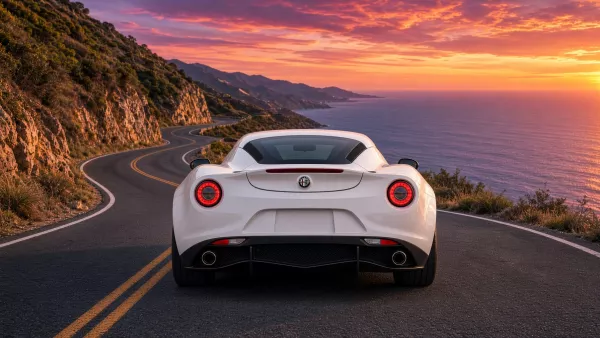
The shape resulted from collaboration between designers and engineers. Large intakes along the rear flanks directed cooling air towards powertrain components. Ventilation openings and the distinct rear spoiler helped define the profile. The low front section contrasted with the pronounced rear wheel arches.
The headlights on early Coupés generated particularly lively discussion. Their exposed lighting elements looked unconventional even by Italian sports-car standards. Later versions, including the Spider, also used more conventional enclosed headlamp assemblies, changing the expression of the front end without fundamentally altering the body shape.
The doors opened onto broad sills formed by the carbon-fibre cell. Getting inside required practice: the driver had to lift their legs over a high sill before lowering themselves into a seat mounted close to the floor. Sections of the composite monocoque remained exposed inside the cabin. Carbon fibre was therefore more than a hidden engineering material; it was part of the interior's visual identity.
The two-seat cockpit featured digital instruments, a simple centre console and few places to store personal belongings. The designers made little attempt to create a luxurious environment. Certain plastics and trim details fell short of what some buyers might expect at this price. The more distinctive elements were the driving position, visible carbon fibre, aluminium details and the engine immediately behind the occupants.
Practicality was limited. The small luggage compartment, high sills, minimal sound insulation and lack of storage made longer journeys less convenient. These compromises were not accidental oversights. The 4C had been engineered around priorities very different from those of a comfortable touring car.
Alfa Romeo 4C Spider: open-air driving without a change in philosophy
At the Geneva Motor Show in March 2014, Alfa displayed a Spider concept previewing an open-top version. The finished production Spider was unveiled in Detroit in January 2015 before being introduced in European markets.
It retained the Coupé's general architecture, four-cylinder engine and dual-clutch transmission. Changes concerned the upper passenger-cell structure, body components and arrangements needed to maintain stiffness and safety. These included a specially engineered carbon-fibre windscreen frame. Above the occupants was a removable fabric roof, rather than a complex powered folding-roof mechanism.
The weight difference between the two body styles was relatively modest, although figures depended on market specification and equipment. In American tests, Car and Driver found a difference of roughly 18 kg between the particular Coupé and Spider it weighed. That comparison does not mean that every Spider is exactly 18 kg heavier than every Coupé.
The character of the journey changed more than the underlying car. With the roof removed, engine and exhaust noise became more prominent and the mechanical sensation more immediate. Yet the Spider did not turn into a comfortable grand tourer. It remained an open version of an uncompromising lightweight sports car.
Other changes included wheel designs, interior finishes, more conventional headlamps and an optional Akrapovič exhaust. It is important to distinguish components shown on the 2014 Spider concept from equipment actually offered on subsequent production cars.
Special editions: from Launch Edition to 33 Stradale Tributo
The first important special edition was the 4C Launch Edition, unveiled in Geneva in 2013. It included distinctive styling details, numbered identification, carbon-fibre components and additional equipment. Alfa allocated 400 cars to Europe, Africa and the Middle East, 500 to North America and 100 to other markets. The planned series therefore comprised 1,000 cars divided among regions, rather than 400 examples worldwide.
Two more editions appeared in 2018: the 4C Competizione and the 4C Spider Italia. Alfa announced 108 examples of each, a reference to the marque's 108th anniversary. The Competizione featured details including matt Grigio Vesuvio Opaco paint, carbon-fibre components and sporting trim. The Spider Italia offered a different, more elegant combination of exterior colour and detailing. Neither was a new technical generation of the 4C.
The final especially significant chapter was the 4C Spider 33 Stradale Tributo, announced in December 2020. Only 33 examples were intended for the North American market. Each received Rosso Villa d'Este paint, grey-gold wheels, distinctive upholstery and details recalling the original 33 Stradale. One unusual feature was the red finish applied to the carbon-fibre monocoque visible inside the car.
The distinction matters: the 33 Stradale Tributo marked the end of the North American 4C Spider programme. It did not introduce a separate mechanical model with a V8, nor was it a revival of the original 1960s 33 Stradale. It was a limited farewell edition of the existing car, valued for its design details, rarity and symbolism.
In 2023, Stellantis's Heritage department also presented the “4C Designer's Cut” project, linked to the production model's tenth anniversary and Alessandro Maccolini's involvement. It concerned an individually finished example conceived as part of a programme reinterpreting cars after their original production runs. This should be kept separate from the initial factory range of road-going 4C editions.
Production in Modena and the limits of scale
Assembly took place at Maserati's plant in Modena. That location mattered technically and commercially: Alfa made use of manufacturing facilities associated with low-volume sports cars. The final production process joined the composite monocoque and aluminium structures with the drivetrain, suspension and exterior body panels.
The manufacturer highlighted extensive dimensional checks and hands-on work. Its 2013 material referred, among other things, to examining body structures at hundreds of measurement points and road-testing every completed car. Production was not improvised, although the technology differed considerably from a mainstream compact-car assembly line.
At launch, Alfa discussed annual production capability of up to approximately 3,500 vehicles under its planned production and supply arrangements. This was a proposed limit or capability, not evidence that the plant actually built that number every year. With composite-part supply constraints, labour-intensive operations and niche demand, the 4C remained a relatively low-volume model.
Quoting a single apparently exact total is unhelpful when available counts do not consistently distinguish Coupés, Spiders, model years, cars delivered to individual markets and possible pre-production vehicles. What can be established is that the 4C was never manufactured on a mass-market scale. Its limited volume reflected both the chosen technology and its market positioning.
Prices and market position
The 4C was never an inexpensive car. In March 2013, European Launch Edition pricing was announced at around €60,000, depending on the country and local taxes. In Poland, Alfa Romeo's official announcement gave a price of PLN 250,000 including tax for the Launch Edition. The standard Coupé, introduced later as a regular production model, was positioned below that initial special edition.
Those prices placed it among demanding competitors. A buyer considering a Porsche Cayman could choose a more versatile sports car with higher perceived interior quality and greater practicality. The lightweight sports-car market also included the Lotus Elise and Exige. Alfa offered a different proposition: carbon-fibre monocoque construction, distinctive bodywork and an experience closer in spirit to exotic machinery.
In the United States, the car's importance went beyond its individual sales. It helped reintroduce Alfa Romeo to a market where the brand had been largely absent from regular new-car showrooms. Even so, the 4C was never expected to generate substantial mainstream sales on its own. That role later passed to the Giulia and Stelvio.
When the end of the American Coupé was announced in 2018, the Spider remained available. European availability of the various versions was reduced at different times depending on the country and changing homologation requirements. The final North American Spider edition was announced towards the end of 2020. Saying that the entire 4C family was produced simply “from 2013 to 2020” is a useful shorthand, but obscures the differences between body styles, markets and model years.
Weaknesses and the realities of ownership
Living with a 4C requires accepting the limitations built into its design. The first is ride comfort. Its short wheelbase and firm suspension make even modest road imperfections noticeable. Then there is noise, with drivetrain, exhaust and tyre sounds entering the cabin. Everyday ergonomics present another challenge, from climbing over the broad sill to managing the very limited luggage space.
The unassisted steering demands muscle at parking speeds. At higher speeds, it can kick back strongly over ruts and bumps, particularly with aggressive wheel alignment or performance tyres. These characteristics cannot simply be eliminated by driving differently, although correct suspension adjustment and tyres in good condition can considerably change the experience.
Maintenance costs must also account for the timing belt on the 1750 engine. The European 4C handbook specified replacement at five-year intervals irrespective of mileage, or as frequently as every four years under severe operating conditions. Owners should always follow the schedule appropriate to the particular car's model year and market.
Specialist buying guides also emphasise checking mechanical and suspension fixings, including connections associated with the composite structure. With unusual construction materials, documented servicing, correct wheel alignment and qualified assessment of accident damage are especially important. Repairing a structural carbon-fibre component is a very different proposition from straightening a conventional steel wing.
Expensive maintenance, firm suspension and a noisy interior do not, by themselves, demonstrate poor reliability. Isolated owner reports should be distinguished from documented faults affecting a defined production group. A used example should be assessed through its actual engine, TCT gearbox, suspension, brakes and carbon monocoque, rather than through general assumptions about the Alfa Romeo badge.
Was the 4C a racing car?
The road-going 4C had many characteristics associated with racing: low weight, a mid-mounted engine, a carbon passenger cell and firm suspension. That did not make it the homologation version of a particular factory GT racing car. Its principal purposes were road use, occasional circuit driving by private owners and strengthening Alfa Romeo's sporting image.
Competition projects appeared that drew on the 4C visually or mechanically, but they need to be distinguished from the production model. One example was the Picchio 4C, developed for silhouette-class hill-climb competition with an engine and technical configuration far removed from the standard Coupé. Results achieved by such a vehicle cannot simply be credited to the car sold in Alfa Romeo showrooms.
The production 4C's importance lies more in its engineering philosophy than in a factory racing record. It brought the structural idea of a carbon-fibre racing-prototype cockpit to a road-legal vehicle, while combining it with a production-derived four-cylinder engine and normal road-car homologation.
Why Alfa Romeo never built a second-generation 4C
The 4C emerged from a particular convergence of circumstances. Alfa Romeo needed a conspicuous image-building model; the Fiat Chrysler group had suitable sports-car manufacturing facilities in Modena; and collaboration with specialist suppliers made a carbon monocoque possible at a price below that of a typical supercar.
It was nevertheless a difficult proposition to develop over a long period. Two seats, minimal luggage space, a loud cabin and limited opportunities to automate production narrowed its potential customer base. At the same time, safety and emissions requirements were changing, and buyers increasingly expected better comfort and equipment even in small sports cars.
No direct second-generation 4C followed the end of production. That did not mean Alfa Romeo had abandoned performance cars. During the second half of the 2010s it concentrated on the rear-wheel-drive Giulia and later the Stelvio, while in 2023 it presented the strictly limited new 33 Stradale. These were vehicles with different objectives and architectures, however. Describing any of them as a straightforward successor to the 4C would be misleading.
Legacy: an engineering demonstration rather than an all-round ideal
The Alfa Romeo 4C demonstrated that a material more commonly associated with substantially more expensive supercars could form the centre of a compact road-going sports car. Just as importantly, its concept was consistent: minimising mass influenced engine selection, suspension design, equipment levels and even the way occupants entered the cabin.
There was a considerable practical price for that consistency. The car did not always deliver the reassuring balance and precision its specifications might suggest. The Porsche Cayman was often more versatile, while the Lotus Elise represented a different and sometimes even more austere approach to lightness. Neither comparison erases the Alfa's distinctive character.
Today, the 4C is particularly interesting as a completed project without a direct replacement. Its factory carbon-fibre monocoque, transversely mounted engine, lack of steering assistance and compact two-seat cockpit form a combination that remains unusual among modern road cars. Collector interest reinforces its appeal, although rising prices for individual examples should not be mistaken for an unquestionable trend across the entire market.
The 4C's greatest contribution to Alfa Romeo was to demonstrate that sporting character could be engineered into the foundations of a car rather than added through styling or engine output alone. It was uncomfortable, occasionally demanding and deliberately incomplete as an everyday vehicle. It also helped restore credibility to Alfa Romeo as a manufacturer of genuinely focused small sports cars. Its story is one of engineering boldness, and of how much everyday convenience Alfa was prepared to sacrifice to preserve it.