Mercedes-Benz
Mercedes-Benz traces its origins to Karl Benz's 1886 Patent-Motorwagen - widely recognized as the first internal combustion automobile - and Gottlieb Daimler’s early motor carriages. The official brand formed in 1926 through the merger of Benz & Cie. and Daimler-Motoren-Gesellschaft, taking the Mercedes name from a 1901 Daimler model named after Mercédès Jellinek. Headquartered in Stuttgart, Germany, the company built its reputation on engineering safety innovations, luxury refinement, and motorsport dominance with its historic "Silver Arrows" racing teams.
The manufacturer's legacy features landmark models including the 1950s 300 SL "Gullwing," the rugged G-Class off-roader, and the S-Class sedan, which has introduced many safety and technical standards to the broader auto industry. High-performance models are developed under the Mercedes-AMG division, while ultra-luxury vehicles carry the Mercedes-Maybach nameplate.
Operating today as Mercedes-Benz Group AG, the automaker produces a portfolio spanning luxury sedans, crossovers, SUVs, and commercial vehicles. Its strategy focuses on electrification and vehicle software, transitioning toward battery-electric models alongside performance hybrids and certified Level 3 conditional autonomous driving systems.
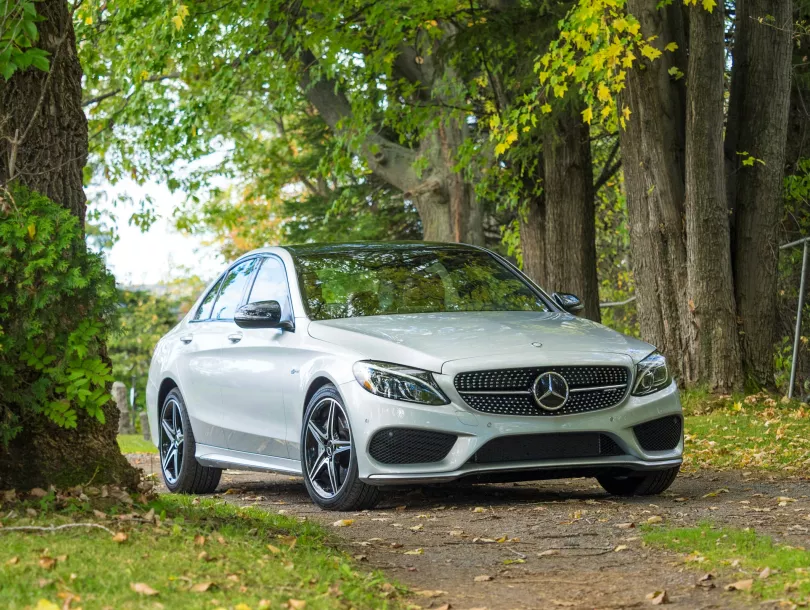
Models over time
Mercedes-Benz 300 SL
Mercedes-Benz 600
Mercedes-Benz CLK GTR Straßenversion
Mercedes-Benz SLR McLaren
Mercedes-Benz SLS AMG
Mercedes-AMG GT
Mercedes-Maybach S-Class
Mercedes-Maybach GLS
Mercedes-AMG ONE
Mercedes-Maybach SL 680 Monogram Series
Data
Registration
Facts
Mercedes-Benz quoted 0–100 km/h in 3.8 seconds and a 332 km/h top speed for the SLR McLaren Roadster.
The SLR McLaren's M155 was a hand-assembled, supercharged 5,439 cc V8 producing 460 kW, or 626 PS.
The SLR McLaren used the SBC electrohydraulic braking system with carbon-fibre-reinforced ceramic brake discs.
Mercedes-Benz stated that the SLR's carbon structure was about 30% lighter than a comparable front-mid-engined sports car with a steel body.
The SLR McLaren was the first series-production Mercedes in which the complete body-in-white, monocoque, doors and panels were made from carbon-fibre-reinforced plastic.
The Petersen Automotive Museum lists the road-going 6.9-litre CLK GTR at about 612 hp.
For the road car, the racing V12's displacement was increased from 6.0 to about 6.9 litres.
The road-going CLK GTR shared the core suspension architecture of the racing car, while receiving a more civilized interior.
The road-going CLK GTR retained a carbon-fibre monocoque closely related to the racing car's structure.
The W 100's equipment included power steering, central locking and an electronically controlled heating and ventilation system.
More facts about Mercedes-Benz
Showing 21–30 of 100 facts