McLaren
McLaren Automotive traces its roots to 1963, when New Zealand racing driver Bruce McLaren established Bruce McLaren Motor Racing. Headquartered at the McLaren Technology Centre in Woking, Surrey, the British manufacturer built its reputation on Formula 1 racing success before expanding into serial supercar production. McLaren introduced carbon-fiber chassis construction to Grand Prix racing with the MP4/1 in 1981, a technology that became standard across all its subsequent road vehicles.
The company entered road-car history with the 1992 McLaren F1 - designed by Gordon Murray - which set the record as the world's fastest naturally aspirated production vehicle. Re-established in 2010 as a standalone automaker under McLaren Automotive, the firm structured its model lineup around lightweight carbon monocoque tubs and mid-engine layouts.
Owned by Bahrain's sovereign wealth fund, Mumtalakat, McLaren organizes its core offering around sports cars and supercars. Modern production includes the twin-turbo V8 750S, the Artura plug-in hybrid V6, the GTS grand tourer, and flagship hypercar projects like the W1.
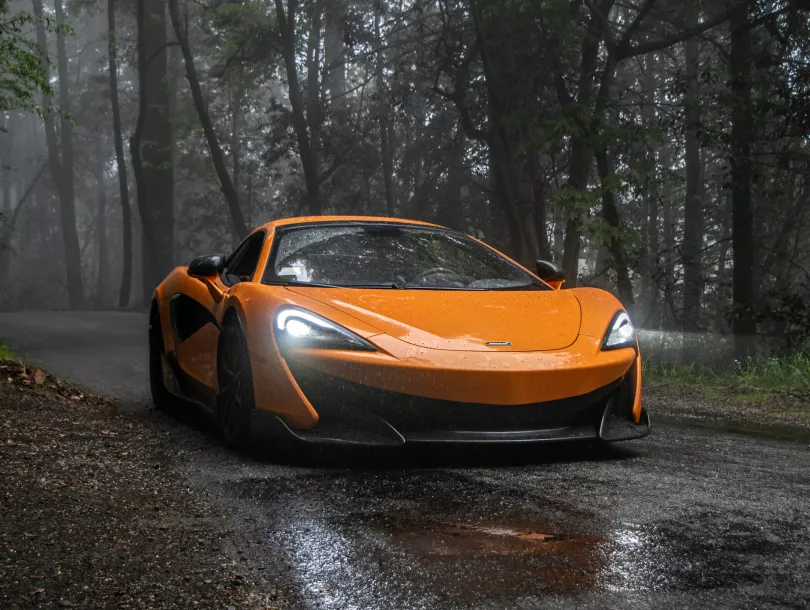
Models over time
McLaren F1
McLaren 12C
McLaren P1
McLaren 650S
McLaren 720S
McLaren Senna
McLaren Elva
McLaren Speedtail
McLaren Artura
McLaren 750S
McLaren Solus GT
McLaren W1
Data
Registration
Official recall campaigns.
Facts
The McLaren Senna engine produces 800 PS.
The Senna uses a 4.0-litre twin-turbo V8 with dry-sump lubrication.
McLaren quotes a minimum dry weight of 1,395 kg for the P1.
The P1's active aerodynamic devices, including its movable rear wing, can generate around 600 kg of downforce.
The P1's combined maximum torque is 900 Nm.
The P1's combined powertrain output is 916 PS.
The P1 combines a 3.8-litre twin-turbo V8 with an electric motor.
The F1 engine bay uses a thin layer of gold as an effective radiant-heat shield around the V12.
The F1 uses a naturally aspirated V12 developed by BMW Motorsport specifically for the McLaren project.
The McLaren F1 was the first production road car built around a carbon-fibre monocoque.
More facts about McLaren
Showing 21–30 of 120 facts