Lancia
Lancia was founded in Turin in 1906 by racing drivers Vincenzo Lancia and Claudio Fogolin. The Italian automaker built its early reputation on engineering innovations, debuting the first mass-production unibody chassis with the Lambda in 1922 and the first production V6 engine in the 1950 Aurelia.
The brand cemented its legacy in motorsport through its dominance in the World Rally Championship, securing ten constructors' titles with iconic competition cars like the Stratos, 037, and Delta HF Integrale. Acquired by Fiat in 1969, Lancia eventually saw its international market footprint shrink, selling only the Ypsilon hatchback exclusively within Italy for several years.
Now operating as a brand under Stellantis, Lancia is executing a broader European relaunch. Its current lineup centers on a new generation of the Ypsilon offered with electric and hybrid powertrains, alongside plans to revive its historic HF performance moniker for future models.
Models over time
Lancia Stratos
Selected cars
Lancia Stratos
Related articles
Facts
Factory rally Stratos engines, developed in 12- and 24-valve forms, produced up to roughly 300 hp.
The Stratos used a mid-mounted 2.4-litre V6 derived from the Ferrari Dino.
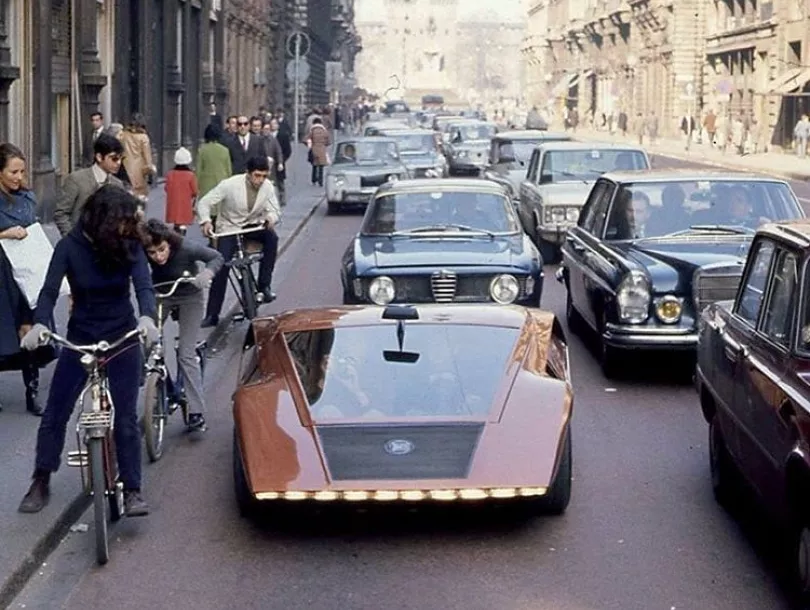
The Stratos's distinctive wedge-shaped body was designed by Marcello Gandini for Bertone.
Sandro Munari won the 1977 FIA Cup for Rally Drivers with results including those achieved in the Lancia Stratos, before the full WRC drivers' title existed.
The Stratos scored three consecutive Monte Carlo Rally victories, cementing its status as a 1970s rally icon.
Lancia won three consecutive World Rally Championship manufacturers' titles with the Stratos in 1974, 1975 and 1976.
On September 23, 1973, the Stratos won the Tour de France Automobile, one of its first major international victories.
The Stratos scored its first competition victory on April 8, 1973, at Spain's Rally Firestone.
The FIA homologated the Lancia Stratos for Group 4 on October 1, 1974.
The Lancia Stratos was conceived from the outset as a rally car, with homologation rules driving the need for a road-going production series.
More facts about Lancia
Showing 1–10 of 10 facts