General Motors Firebird
Key specifications
Generations and variants
General Motors Firebird I
General Motors Firebird I XP-21
- Body style
-
Concept car
- Engine
- Gas turbine
- Drivetrain
-
Rear-wheel drive
General Motors Firebird II
General Motors Firebird II XP-43
- Body style
-
Concept car
- Engine
- Gas turbine
- Drivetrain
-
Rear-wheel drive
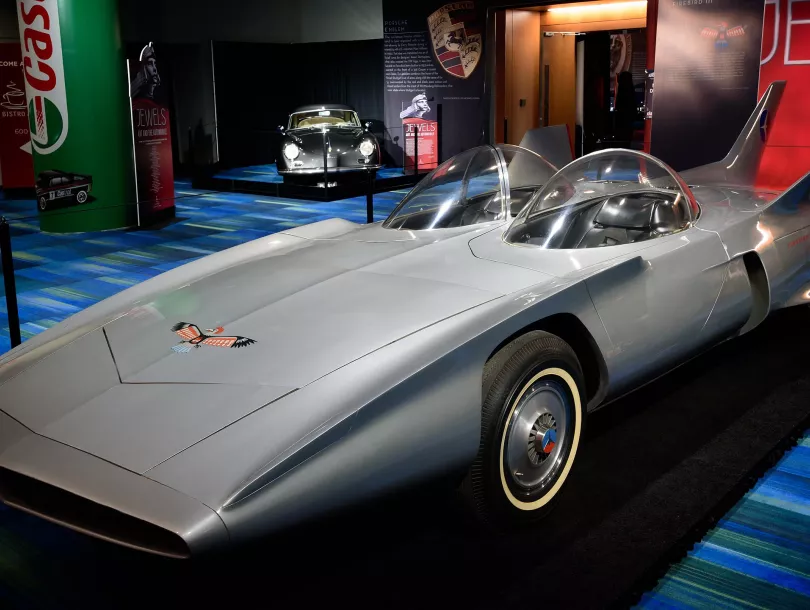
General Motors Firebird III
General Motors Firebird III XP-73
- Body style
-
Concept car
- Engine
- Gas turbine
- Drivetrain
-
Rear-wheel drive
Facts
Firebird II combined a regenerative gas turbine with four-wheel independent suspension, automatic load levelling and power-assisted disc brakes.
Firebird II used a titanium body, an exceptionally unusual material for a 1950s concept car.
The Whirlfire Turbo-Power turbine in Firebird I could produce about 370 hp and transmitted its power mechanically to the rear wheels.
General Motors describes Firebird I as the first gas-turbine automobile built and tested in the United States.
The turbine-concept programme was not technically related to the Pontiac Firebird, although its name was later used for the production Pontiac model from 1967.
Firebird II debuted at the 1956 GM Motorama as a four-passenger successor to the first prototype.
GM presented the Firebird I XP-21 as an experimental gas-turbine car in 1954.
GM states that surface details from the 1958 Firebird III influenced production Cadillacs for 1959 and 1961.
The Firebird I idea originated with GM Styling vice president Harley J. Earl, who gave it an aircraft-inspired fibreglass-reinforced body.
The Firebird I's surfaces were refined in the California Institute of Technology wind tunnel, an unusually early use of such testing for an automobile.