DeLorean DMC-12
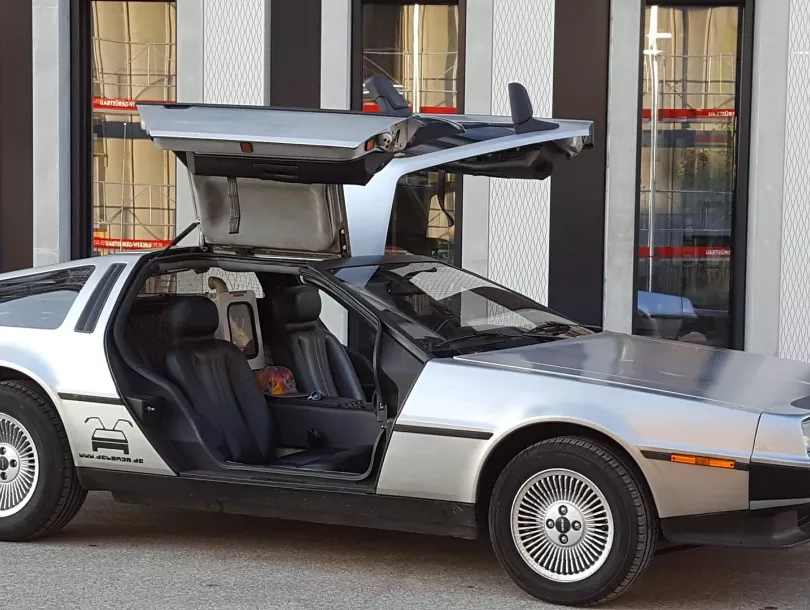
DeLorean Motor Company, founded by former General Motors executive John DeLorean, produced the DMC-12 between 1981 and 1982 at a factory in Dunmurry, Northern Ireland. Designed by Giorgetto Giugiaro at Italdesign, the sports car stood out for its unpainted, brushed stainless-steel outer body panels, gull-wing doors, and a fiberglass structure mounted on a Lotus-engineered steel backbone chassis.
Power was provided by a rear-mounted 2.85-liter PRV (Peugeot-Renault-Volvo) V6 engine generating 130 horsepower, mated to either a five-speed manual or a three-speed automatic transmission driving the rear wheels. While modest performance, buildup quality issues, and rapid financial failure halted production after roughly 9,000 units, the DMC-12 gained worldwide renown as the time machine in the Back to the Future film franchise.
Key specifications
Differences between variants
| Specification | DeLorean DMC-12 | DeLorean DMC-12 |
|---|---|---|
| Engine | 2.85 l · V6 | 2.85 l · Naturally aspirated · V6 |
| Production period | Not recorded | 1981-1983 |
Generations and variants
DeLorean DMC-12
DeLorean DMC-12
1981-1983- Body style
-
Coupe
- Engine
- 2.85 l · Naturally aspirated · V6
- Power
- 96.94 kW
- Drivetrain
-
Rear-wheel drive
- Transmission
-
Multiple transmission options· 5 speeds5-speed manual or 3-speed automatic
Facts
The DMC-12's gullwing doors are assisted by torsion bars and gas struts, allowing the large doors to be raised with manageable effort.
Beneath the stainless panels, the DMC-12 used a moulded composite body structure formed from two main bonded halves.
Museum sources record that roughly 9,000 DMC-12s were built during the factory's short operating life.
Main production at Dunmurry stopped at the end of May 1982, although some additional cars were later completed from remaining parts.
Series production of the DMC-12 at Dunmurry began in 1981.
In 1978, an agreement was reached to build DeLorean's Dunmurry factory in Northern Ireland specifically for the DMC-12 program.
DeLorean Motor Company entered receivership in February 1982 as the program's financial problems rapidly worsened.
The DMC-12's outer panels were made from brushed stainless steel left unpainted, becoming the car's most recognizable feature.
Lotus assisted in bringing the DMC-12 design to production readiness when the program needed rapid industrial development.
By the end of 1981, the factory had produced about 7,500 cars but sold roughly 3,000, creating a serious inventory and cash-flow problem.