The first-generation BMW 8 Series, known internally as the E31, was a luxury 2+2 coupé produced from 1989 to 1999. When it made its debut at the Frankfurt Motor Show in 1989, it offered retractable headlights, a twelve-cylinder engine, an available six-speed manual transmission and an unusually sophisticated electronic architecture. Yet this was no lightweight sports car. BMW had designed a fast, expensive and comfortable grand tourer intended to cover long distances at sustained motorway speeds.
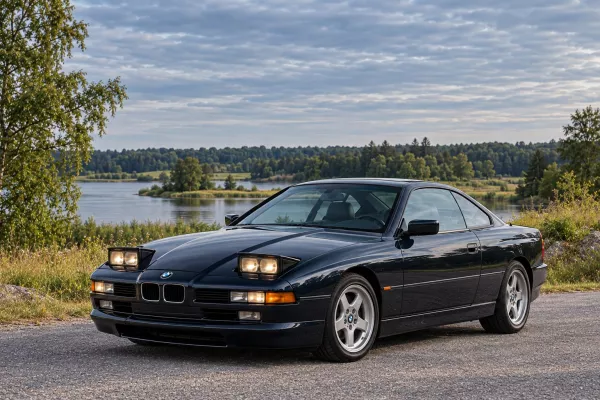
The E31's history is more complicated than its present-day reputation as a collector's classic. It took over the place occupied by the older 6 Series coupé, but aimed considerably higher in price, construction and prestige. Its launch was followed by an economic downturn, while its refinement and elaborate equipment did not win over every driver expecting the agility traditionally associated with BMW. During its ten-year life, the range included the 850i, 850Ci and 840Ci, along with the BMW M-developed 850CSi. A planned convertible and the radical M8 prototype never reached series production.
From the 6 Series to a flagship coupé
By the 1980s, BMW already had considerable experience building elegant, fast coupés. The E24 6 Series combined a large straight-six engine, traditional proportions and rear-wheel drive. As the years passed, however, it increasingly lagged behind the marque's newer saloons in safety, aerodynamics and electronic equipment. Its replacement was intended to be more than another update of a familiar formula.
Design work on the new car began in the mid-1980s. BMW identifies 1984 as the year in which Klaus Kapitza produced the first sketches; his proposal won an internal design competition. Development continued under the department headed by then design chief Claus Luthe. These are distinct roles: Kapitza is associated with the E31's exterior form, while Luthe oversaw the direction of the design department as a whole.
The number 8 announced a different position within BMW's hierarchy. The E31 was not simply the next generation of 6 Series with a larger engine. It was meant to sit above that car and demonstrate BMW's engineering capabilities, much as the 7 Series did among saloons. In 1987, BMW introduced the E32-generation 750i and 750iL with a five-litre V12. That engine provided a natural starting point for the new flagship coupé.
There were several competing interpretations of the grand tourer in this market. Mercedes-Benz offered a substantial S-Class coupé, Porsche pursued a sportier approach with the 928, and Jaguar had its own tradition of combining long-distance travel with V12 power. BMW sought to blend refinement, sophisticated technology and athletic proportions. The result was never intended as a direct rival to a small, lightweight sports car.
Frankfurt debut and the start of production
The 850i made its world debut at the Frankfurt IAA in September 1989. The first E31 cars were built in 1989, and production of the generation continued until May 1999. Depending on the market and model year, sources place the start of sales in either 1989 or 1990. Those dates describe different stages of the same launch, from public presentation and the start of production to customer deliveries.
The car's shape made an immediate impression. Low, wide and remarkably free of visual ornament, it combined a long bonnet with a flattened nose and retractable headlights. Even at rest, its proportions suggested speed. Aerodynamic development and computer-assisted design helped BMW achieve a drag coefficient, Cd, of approximately 0.29, an impressive figure for a large coupé at the end of the 1980s.
The initial range was straightforward: a rear-wheel-drive 850i powered by a V12, with a choice of a six-speed manual gearbox or a four-speed automatic. In Germany, its price was around 135,000 Deutsche Marks. That placed it well above ordinary versions of the 5 and 7 Series and demanded that buyers accept the running costs associated with its expensive engineering.
Exterior design: wedge, glass and aerodynamics
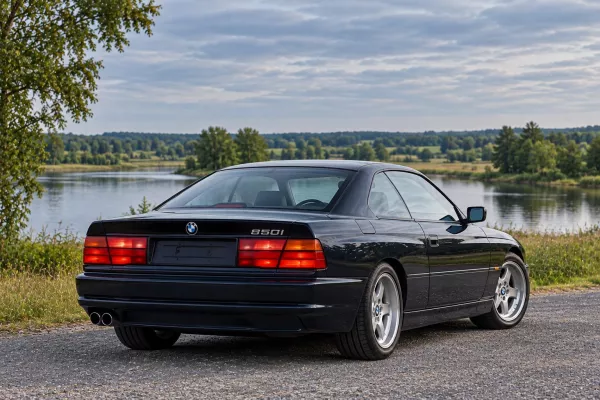
The E31 measures 4,780 mm in length and 1,855 mm in width, with a 2,684 mm wheelbase. Height varies by version and measurement convention; BMW quotes 1,330 mm for the 850CSi. These proportions explain why it can look even lower than its dimensions suggest. The long bonnet gives way to a compact-looking passenger compartment, while the rear ends in a relatively short, high-set boot.
The most recognisable feature remains the retractable headlamp arrangement. With the dipped beams switched off, the main lamps disappear into the bonnet, leaving slim auxiliary lighting units and an unusually flattened interpretation of BMW's twin-kidney grille. The arrangement preserved an uninterrupted line across the front of the car, although the additional mechanisms now require maintenance.
From the side, the absence of a fixed central pillar between the front and rear side windows is particularly striking. Lower all the windows and the result is an unusually long, open glazed area. The frameless door windows drop slightly when a door opens, then rise again when it closes. That small movement makes it possible to combine a clean window arrangement with effective sealing.
BMW did not establish the E31's identity with an enormous rear wing or exaggerated creases. Its broad, smooth surfaces marked a deliberate departure from the more angular E24. The low drag coefficient was significant, but Cd alone does not determine total aerodynamic resistance; frontal area also matters. The E31 was carefully streamlined without ceasing to be a large, wide car.
The interior follows the familiar BMW principle of orienting the controls towards the driver. The centre console is angled slightly inwards, while the instruments use a legible, conventional layout. Substantial seats, a broad transmission tunnel and solid trim give the cabin the feel of an expensive grand tourer. There are two rear seats, but limited legroom and the low roof restrict their usefulness. The 2+2 layout is best understood as accommodation for two people with the occasional ability to take additional passengers.
Structure and chassis: comfort at high speed
The E31 drew on technical solutions associated with the contemporary E32 7 Series, but it was not merely a shortened saloon with two doors. Its body and chassis were developed around the requirements of a heavy, fast coupé. The steel monocoque had to retain adequate rigidity despite large door openings and the absence of conventional central pillars.
One of its defining features was the multi-link rear suspension, known in BMW terminology as the integral rear axle. The geometry was designed to limit undesirable changes in wheel alignment under braking, acceleration and suspension movement. Its purpose was to combine stability at high speed with the ability to absorb uneven road surfaces, rather than to make the car react abruptly to every steering input.
Depending on market, version and optional equipment, an E31 could feature ABS, ASC+T traction control, speed-sensitive power steering and electronically controlled EDC dampers. Such systems were far from universal among powerful coupés at the time. They gave engineers more control over the car's behaviour but also increased the number of sensors, pumps, control units and electrical connections that would eventually need attention.
Another important feature was the integration of the car's electronic systems through communication between control units. Rather than relying entirely on separate wiring for every device, BMW used shared data paths to coordinate a growing number of functions and reduce wiring complexity. It would be misleading, however, to describe every electrical circuit in the E31 as part of a single modern vehicle network. The car employed several arrangements and generations of electronic communication.
Weight was the other side of this technological ambition. BMW quoted around 1,790 kg for an early 850i in one factory configuration, but figures vary with version, equipment and weighing method; tests of heavily equipped examples sometimes produced considerably higher numbers. Power-operated equipment, extensive sound insulation and luxury features all added mass. The E31 was more at ease covering distance quickly and smoothly than negotiating a succession of tight corners.
The M70 V12: smoothness rather than spectacle
The original 850i used the M70B50, a naturally aspirated 4,988 cm³ V12. According to BMW's figures, it produced 220 kW (300 metric horsepower, or PS) and 450 Nm of torque. Its basic architecture came from the 750i, adapted to the role of a large luxury coupé.
The engine's character was defined less by its peak power than by its remarkably even delivery. With twelve cylinders firing at closely spaced intervals, the driver received a smooth response to the accelerator. BMW also insulated the E31 effectively enough that the V12's sound rarely dominated the cabin during ordinary driving.
The M70 used one camshaft per cylinder bank and two valves per cylinder. Its electronically controlled throttles, governed by the EML system, meant there was no direct mechanical connection dictating throttle opening from pedal position. Electronics could therefore shape the engine's response. The V12 used cooperating control units to manage its two banks of cylinders. That arrangement may sound familiar today, but it was advanced technology around the turn of the 1990s.
In the 850i, the V12 could be paired with a six-speed manual gearbox, setting it apart from many contemporary luxury twelve-cylinder road cars. A four-speed automatic was the alternative. The transmission made a substantial difference to the car's personality: the manual offered greater driver involvement, while the automatic suited the effortless accumulation of speed that defined its grand-touring role.
BMW claimed 0-100 km/h in 6.8 seconds for the early 850i and an electronically limited top speed of 250 km/h. These were impressive figures in 1989, but the deeper achievement was the ease with which the car could deliver sustained high performance without making the driver feel as though it was working hard.
The 850Ci: a new badge and a larger V12
In the early 1990s, BMW revised its naming conventions. The 850i became the 850Ci, but the earliest cars under the newer badge still used the five-litre, 300 PS M70. The 850Ci designation alone therefore does not identify the engine. A particular car's production date and engine code matter.
In autumn 1994, the 5,379 cm³ M73B54 was introduced. Output increased to 240 kW (326 PS) and maximum torque rose to 490 Nm. The revised V12 was coupled to a five-speed automatic, well matched to the relaxed long-distance character of the later 850Ci. BMW's quoted 0-100 km/h time improved to approximately 6.3 seconds, although that figure applies to a particular specification and the manufacturer's test procedure.
The new engine did not fundamentally change the car. It improved flexibility while preserving the characteristic refinement of twelve cylinders. For enthusiasts interested in a conventional manual transmission, the earlier M70 cars remain especially appealing. The later M73 represents the more comfort-oriented side of the 8 Series.
The 840Ci: eight cylinders, the same mission
BMW broadened the range in 1993 with the 840Ci. This was not simply a stripped-down 850i with two fewer cylinders. It retained the overall body, architecture and much of the luxury equipment of the 8 Series, but used a lighter V8. The intention was to lower the entry price and attract buyers who did not necessarily need twelve cylinders.
Early examples received the M60B40, a 3,982 cm³ V8 producing 210 kW (286 PS) and 400 Nm. The 14 PS gap to the basic V12 did not fully describe the difference in character. The V8 delivered its power differently, was less complicated in certain respects and could make the front of the car feel more responsive. Both manual and automatic transmissions were offered in particular market specifications.
From 1996, the updated 840Ci used the 4,398 cm³ M62B44. Power remained at 286 PS, but torque increased from 400 to 420 Nm. The improvement in everyday flexibility mattered more than the unchanged peak output might suggest. BMW quoted a maximum speed of 250 km/h and a 0-100 km/h time of around seven seconds, depending on version.
The 840Ci demonstrated that the E31's identity did not depend entirely on a V12. It remained a quiet, wide and comfortable grand tourer. For an owner intending to use the car regularly, the V8 can make some aspects of engine maintenance less demanding. That does not make it inexpensive to run: the M60 and M62 have their own service requirements, while the elaborate body and electronics are common to the entire family.
BMW 850CSi: the most focused production E31
The 850CSi arrived in 1992 as a version developed with substantial involvement from BMW Motorsport, later BMW M. Unlike the 850i and 850Ci, it required changes to the engine, suspension, brakes and aerodynamics. It was also the only production E31 version BMW offered exclusively with a six-speed manual gearbox.
The S70B56 was derived from the M70, with increased bore and stroke. Capacity rose to 5,576 cm³, output to 280 kW (roughly 380-381 PS, depending on rounding) and torque to 550 Nm at 4,000 rpm. BMW M revised components including the pistons, valve train, air intake and exhaust. Cooling arrangements were also adapted for increased loads, although their exact specification differed between markets.
Top speed was still electronically limited to 250 km/h. BMW quoted a 0-100 km/h time of approximately 6.0 seconds. The largest difference from a normal 850i, however, could not be captured by an acceleration time. Steering calibration was revised, the suspension was lowered and stiffened, the brakes were enlarged, and the drivetrain included a limited-slip differential. Distinctive wheels completed the changes.
Subtly redesigned bumpers, a more pronounced rear aerodynamic element and four exhaust outlets provided visual clues. European cars also featured characteristic BMW M door mirrors. The 850CSi remained restrained by the standards of overtly racing-inspired road cars. Even at its most powerful, the E31 retained the appearance of a large grand tourer.
BMW built 1,510 examples of the 850CSi, including 160 right-hand-drive cars and 225 for the US market. The American version deserves special attention. Compared with European examples, it lacked, among other features, the AHK active rear-steering system, dedicated engine-oil and differential cooling arrangements, and certain European brake and styling components. Comparing two 850CSis without identifying their markets can therefore be misleading.
AHK: the rear axle that helps the car turn
Among the E31 family's more unusual technologies was active rear-axle kinematics, known as AHK, short for Aktive Hinterachskinematik. Standard on the European 850CSi, the system worked with the multi-link rear suspension and an electrohydraulic control arrangement. Depending on driving conditions, it could adjust the rear wheels through a small angle, reaching approximately 1.8 degrees according to BMW.
For a vehicle with a wheelbase of nearly 2.7 metres and a mass approaching two tonnes, the rear axle's response makes a substantial difference to stability. AHK was intended to reduce the delay in the body following a steering input and improve composure during fast lane changes and high-speed bends. That is a different priority from the large opposite-direction rear-wheel angles used by some modern systems primarily to reduce turning circles.
AHK did not turn the E31 into a lightweight track car. It gave engineers another means of controlling a heavy coupé travelling very quickly on the motorway. Today its hydraulic and mechanical components demand specialist knowledge. Their presence contributes to the historical appeal of a European 850CSi, but can also make a neglected example expensive to repair.
On the road: the difference between a GT and a sports car
Period road tests reveal two sides to the E31. Journalists praised the V12's extraordinary smoothness, quietness, high-speed stability and comfortable seats. Yet they also noted the car's considerable weight, limited agility and steering that did not always offer the precision drivers expected of a BMW.
In its 1991 test of the 850i, the American magazine Car and Driver criticised aspects of the manual car's behaviour at very low speeds and its responses to road imperfections. In a later comparison with the Porsche 928 GTS, the magazine praised the BMW's equipment and finish but found it less willing to attack corners than the Porsche. Other contemporary reviewers were more favourable towards the E31's comfort and stability. These judgments are not necessarily contradictory: the BMW excelled on long journeys but revealed the limits imposed by its weight in demanding, short-duration sporting tests.
Acceleration figures also require care. A 0-60 mph test reaches approximately 97 km/h, not 100 km/h, and publications used different procedures and different transmissions. BMW's factory figures of 6.8 seconds for the 850i and 6.0 seconds for the 850CSi are useful reference points, but they are not substitutes for an independent measurement of a specific car.
Practical compromises are easy to identify. The long nose complicates parking, the broad doors need room to open, and the rear seats are poorly suited to long trips with adult passengers. Out on the open road, those priorities make more sense. A stable body, long wheelbase, supportive seats and well-insulated engine allow rapid progress with less effort than a more highly strung sports car demands.
Versions that never reached production: 830i, convertible and M8
BMW considered a broader E31 range than the one customers ultimately saw. One possible entry-level model was the 830i, powered by the three-litre M60B30 V8. Eighteen trial vehicles were built, but the version never went on sale. The more powerful 840Ci eventually took the role of the eight-cylinder entry model.
An open-top body was another possibility. BMW developed and tested E31-based convertible prototypes, but no production model followed. Removing the fixed roof would have demanded costly structural modifications to a car already carrying a large engine and extensive luxury equipment. With limited expected demand, the financial case was uncertain. The original production E31 remained a coupé throughout its life.
The best-known abandoned project was the M8. BMW M built a single radical prototype with widened wheel arches, a revised front end without the usual pop-up headlights, lightweight body components and a six-litre V12. In material published years later, BMW M quoted 6,064 cm³, 640 PS and 650 Nm. Those figures describe a development prototype rather than a homologated production car. BMW itself has noted that no official acceleration measurements were made.
Older factory publications gave different power figures for the experimental V12. It is therefore more accurate to treat the later BMW M specifications as a description of the preserved prototype than as proof of the performance of a production-ready version. The project helped BMW explore high-output twelve-cylinder engines, and the company has also identified links between that development work and the engine created for the McLaren F1. That does not mean the production 850CSi and McLaren F1 shared the same engine.
The M8 prototype never reached showrooms. It remained largely unknown to the public for years before BMW presented it more widely in 2010. Its existence demonstrated how far engineers considered taking the E31 beyond its luxury grand-touring role. A production BMW M8 would not arrive until the much later generation of the 8 Series.
Alpina B12: a different approach to a faster GT
Alpina's interpretations also occupy a special place in the E31 story. The Buchloe-based company developed its own luxury-performance versions of BMW vehicles, with separately prepared engines and chassis. They were more than appearance packages and should not be confused with the production BMW models named 850i, 850Ci or 850CSi.
The Alpina B12 5.0 Coupé developed the five-litre V12 concept to produce approximately 350 PS and 470 Nm, delivered through a four-speed automatic gearbox. It retained a relaxed manner but accelerated and gained speed more readily than the regular 850i. According to historical production records, 97 were made.
The rarer B12 5.7 Coupé was based on 850CSi technology. Its modified engine, with a capacity of approximately 5.7 litres, produced 416 PS and 570 Nm. Alpina claimed a maximum speed above 300 km/h. Those were figures for Alpina's own model, not for the production BMW 850CSi, which remained limited to 250 km/h. Just 57 B12 5.7 examples were built, some fitted with a Shift-Tronic arrangement that allowed gear changes without a conventional clutch pedal.
Alpina production numbers should not simply be added to E31 totals, because these cars were created from existing BMW chassis. They are particularly interesting to collectors, combining the recognisable 8 Series body with an independent manufacturer's history and much smaller production volumes.
Production: how many E31s were actually built?
BMW gives a total of 30,621 E31 cars produced by 1999. Some compilations instead identify 30,603 production examples. The difference of 18 stems from whether the experimental 830i cars are included; adding those prototypes brings the figure to BMW's broader total. The distinction is between all vehicles in the E31 family and the versions offered to customers.
By far the largest group consisted of cars with the five-litre M70 V12, sold as the 850i and early 850Ci. Historical records list 20,072 examples of this configuration. Approximately 1,218 later 850Ci cars used the M73 V12. The M60- and M62-powered 840Ci versions accounted for 7,803 examples combined, while the 850CSi reached 1,510. Despite the introduction of the less expensive V8, twelve-cylinder cars defined the 8 Series more than any other group.
The main production site was Dingolfing in Bavaria. BMW also records 24 cars assembled by hand at its Rosslyn facility in South Africa, where local assembly had tax-related advantages. This was a very small regional operation, not a transfer of the production programme away from Germany.
Over the decade, most buyers preferred automatic transmissions. BMW says only about one in six E31 cars received the six-speed manual. That detail is revealing. Although enthusiasts now place considerable value on manual cars and the 850CSi, the original customers predominantly saw the 8 Series as a luxury vehicle for travel.
Why sales fell short of expectations
The E31 arrived near the end of the 1980s, when an expensive coupé could still make a conspicuous statement of prestige. The market soon changed. The early 1990s brought weaker economic conditions, uncertainty and greater caution among buyers considering cars with very high ownership costs.
The E31's character presented a further challenge. It was expensive without offering the same direct driving experience as some sporting rivals. Buyers who prioritised comfort might instead choose coupés with a more established luxury image. BMW was trying to persuade several different types of customer to accept one expensive and technically ambitious proposition.
The introduction of the 840Ci broadened the range, but did not change the fundamentals of the market. Individual versions were gradually discontinued, with 850CSi production ending in 1996. The 8 Series also disappeared from North America before the end of the wider programme. Production of the E31 finally ended in May 1999, without an immediate successor bearing the same name.
Calling the entire project a failure would nevertheless be too simple. More than 30,000 cars over ten years is modest beside a mass-produced model, but the E31 was always a low-volume, high-priced GT. It did not meet every commercial ambition BMW had for it. At the same time, it gave the manufacturer engineering and design experience that cannot be measured by sales totals alone.
Keeping an E31 on the road: the cost of complexity
Today the 8 Series is a collector's car, but maintaining one still calls for a workshop familiar with the model. Mileage is not necessarily the greatest risk. A rarely driven example with years of deferred maintenance may need more work than one that has been used regularly and cared for correctly.
Cooling systems and ageing rubber components deserve early attention. Hoses, radiators, expansion tanks, water pumps and fans deteriorate whether the engine is a V8 or V12. Overheating a large engine can prove much more expensive than replacing worn components in good time. Twelve-cylinder cars also have more ignition, fuel and engine-control hardware to inspect and maintain.
Early M60 V8 engines are sometimes associated with Nikasil cylinder-lining problems in markets where petrol contained high levels of sulphur. The issue was real, but did not affect every market or every surviving engine equally. For a suspect example, the sensible response is to establish the engine's history and carry out appropriate diagnostics, not to assume that every M60-powered 840Ci is damaged. Other V8 checks include intake and crankcase ventilation leaks, timing-chain guide components and oil seepage.
Electrical comfort systems are another common area of concern. Powered seats, position memory, displays, window mechanisms, climate control and retractable headlights rely on numerous cooperating parts. A failed small control module can be difficult to diagnose and disproportionately costly to repair, particularly if a replacement is no longer readily available. The early 850i additionally uses cooperating engine-management control units and extensive V12 ancillaries.
Suspension bushes, dampers and brake components also wear. A car approaching two tonnes quickly reveals the effects of poor wheel alignment or unsuitable tyres. The 850CSi adds components specific to that variant, including AHK on cars equipped with the system. Some of these parts cannot simply be replaced with items from a normal 850Ci.
Body inspections should look for corrosion around seals, sills and jacking points, signs of older accident repairs and correct operation of every window. Good original corrosion protection cannot make a car immune to age or badly executed repairs. With an E31, working equipment and a documented maintenance history matter more than an attractively low asking price.
The E31 in art and BMW history
The 8 Series' low, clean shape has aged well, but the car also has a literal connection to the art world. In 1995, British artist David Hockney created a BMW Art Car based on the 850CSi. His painted surfaces suggested a view through the bodywork, revealing elements including parts of the engine and the driver's silhouette. His dachshund Stanley also appeared on a rear flank. It was a unique artistic treatment of an existing car, not a new production derivative of the E31.
For BMW, the E31 remains an important chapter in the development of luxury coupés. It brought advanced electronics into this class, demonstrated the possibility of pairing a V12 with a six-speed manual transmission and served as a platform for innovative chassis systems. It also illustrated that the appeal of a grand tourer cannot be determined merely by adding up its technologies.
After the E31 ended, BMW returned to large coupés with the new 6 Series in 2003. The 8 Series name did not return until 2018, attached to an entirely new model family rather than a technical continuation of the E31. Despite the shared number and grand-touring idea, the generations need to be understood separately.
Legacy: a car best understood as a grand tourer
The BMW E31 is sometimes portrayed today as a forgotten supercar of the 1990s. The description captures some of its fascination but obscures its real purpose. The 850i's defining quality was not an ability to challenge a light Porsche on a winding road. It was the combination of a smooth V12, quietness, technical sophistication and exceptionally fast travel without undue effort. The 840Ci proved that the concept also worked with eight cylinders, while the 850CSi pushed it towards a more involving driving experience.
The range is instructive in its own right. Beneath the same body are cars with very different personalities: the early manual 850i, the more relaxed M73-powered automatic 850Ci, the mechanically more approachable 840Ci and the rare, demanding 850CSi. Alpina's B12 models and the unrealised M8 demonstrate the potential inherent in the basic design, but neither should be mistaken for ordinary production BMW variants.
The E31's most interesting paradox is that the technology which made it so distinctive in 1989 is now its greatest maintenance challenge. Electronics, hydraulics, controlled damping and a vast array of equipment all demand patient, specialist care. Yet a well-kept E31 does not need extraordinary acceleration figures or rarity to justify its appeal. It is a coherent grand tourer from an era when BMW set out to build an exceptionally modern coupé while retaining the refinement of a twelve-cylinder engine and the traditional advantages of rear-wheel drive.